
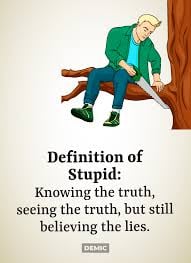
 Stupidity is the lack of intelligence, understanding, reason, or common sense, often manifesting as an inability to learn or profit from experience.
It can refer to a general lack of mental capacity or a specific action or behavior that is foolish or unwise.
The quality or state of being slow of mind, dull in feeling, or lacking good judgment. It is often considered the opposite of intelligence.
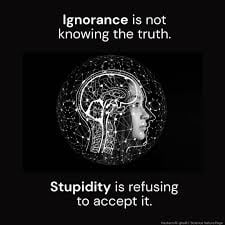
Some distinguish stupidity from ignorance by defining stupidity as a choice to act against one’s own interest or to prevent adaptation to new data, even when one should know better.
Ignorance, by contrast, is simply a lack of information.
Psychologically, stupidity can be seen as an outcome of cognitive biases or errors in judgment.
The Dunning–Kruger effect, describes the bias where people with low ability in a certain area overestimate their competence.
Some argued that stupidity can be a more dangerous enemy to society than evil, as stupid people cannot be reasoned with and act with conviction, making them capable of any evil without seeing it as
“Stupid is as stupid does,”means that one’s intelligence should be judged by one’s actions.
Anyone is capable of a stupid act, true stupidity often involves a lack of self-awareness and an unwillingness to question one’s own beliefs or learn from mistakes.
Stupidity is weaponized incompetence in the face of obvious reality.
Stupidity as a general concept: Acting without thinking, making decisions that disregard obvious facts, or repeatedly doing something that doesn’t make sense.
As a description of an action stupidity usually means the action—not the person—was careless or avoidable.
Sometimes people use it to express frustration, though it’s not usually helpful or precise.