
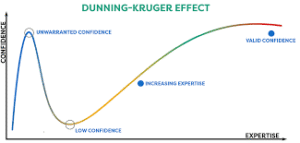
 The Dunning-Kruger effect is a cognitive bias in which people with low ability in a specific area greatly overestimate their competence.
This overestimation occurs because they lack the metacognitive skills or the ability to think about their own thinking, needed to accurately assess their own performance and recognize their shortcomings.
The core idea is that the skills required to perform competently are often the same skills required to evaluate that performance.
Charles Darwin wrote “Ignorance more frequently begets confidence than does knowledge”.
Individuals not only make mistakes due to a lack of knowledge, but their lack of knowledge also prevents them from realizing they are making mistakes.
Highly skilled individuals may, in contrast, tend to underestimate their abilities, assuming that tasks that are easy for them are also easy for others.
This is sometimes referred to as imposter syndrome.
The effect applies to specific skills and knowledge domains, not a person’s overall intelligence.
A brilliant scientist, for example, might still fall victim to the effect in an area where they lack specific training, such as writing or social skills.
The Dunning–Kruger effect: you don’t know what you don’t know
How to Mitigate the Effect: Seek Feedback: Actively ask for constructive criticism from people who are knowledgeable and trustworthy in the specific area.
Continue Learning: As more knowledge is gained, a person becomes more aware of what they still need to master.
Be willing to challenge your own beliefs and assumptions and consider alternative viewpoints.
Consult Experts: When making important decisions, especially in complex areas like healthcare or finance, consult with established experts rather than relying solely on personal, potentially uninformed, judgment.
The least competent performers dramatically overestimate their ability, sometimes ranking themselves in the top 10–20 % when they’re actually in the bottom quartile.
The most competent performers slightly underestimate their ability because they assume tasks that are easy for them are also easy for others.
People with low skill often lack the metacognitive ability to recognize their own incompetence-ignorance of their ignorance”).
The effect is strongest at the extreme low end; average performers estimate themselves fairly accurately.
The general pattern of low performers overestimating, and high performers slightly underestimating has been replicated many times.
The effect is weaker or reversed in some East-Asian cultures where humility norms are stronger.