
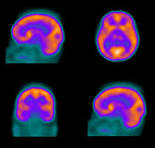
 SPECT is an acronym for Single-Photon Emission Computed Tomography, a nuclear medicine imaging technique that provides 3D images showing how organs and tissues function, particularly their blood flow.
It is distinct from scans like MRI or CT, which primarily show the physical structure of organs.
SPECT scan: a small amount of a radioactive substance, or radiotracer, is injected into a vein, swallowed, or inhaled.
This tracer travels through the bloodstream and collects in specific organs or tissues.
The tracer emits gamma rays, which are detected by a special camera (gamma camera) that rotates around the patient.
A computer then uses this information to create detailed, three-dimensional images that highlight areas where the tracer has accumulated.
SPECT scans are commonly used to diagnose and monitor a variety of conditions, particularly in the brain, heart, and bones.
It can help evaluate blood flow patterns to diagnose conditions such as Alzheimer’s disease and other forms of dementia, Parkinson’s disease, seizures, epilepsy, stroke, and traumatic brain injury.
Used to assess blood flow to the heart musclemyocardial perfusion imaging, to identify clogged coronary arteries, to find damage from a heart attack/scar tissue, and evaluate heart function.
Can detect hidden stress fractures, bone infections, and cancer that has spread to the bones.
Other Applications: SPECT imaging is also used in cancer staging, diagnosing gallbladder issues, and locating inflammation or infection in other organs like the liver, kidney, or spleen.
Hybrid SPECT/CT scanners combine the functional information from a SPECT scan with the detailed anatomical images from a computed tomography (CT) scan.
This allows doctors to pinpoint the exact location of abnormal activity within the body’s structures, leading to a more accurate diagnosis.
SPECT scans use a small, safe dose of radiation, and the benefit of diagnosing serious medical conditions typically outweighs the minimal risks of this radiation exposure.
The radiotracer usually leaves the body naturally within a few hours to days.
Pregnant women should not have a SPECT scan, and breastfeeding mothers may need to take special precautions, such as temporarily stopping breastfeeding.