
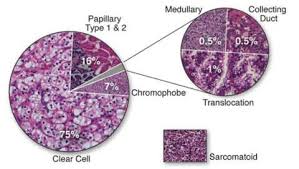
 Non-clear cell renal cell carcinoma (nccRCC) is a term for a group of kidney cancers that do not exhibit the classic clear cell histology.
These tumors account for approximately 20–25% of all renal cell carcinomas and are biologically and clinically distinct from clear cell RCC, which is the most common subtype.
The major subtypes of nccRCC include papillary RCC, chromophobe RCC, translocation RCC, renal medullary carcinoma, fumarate hydratase-deficient RCC, collecting duct carcinoma, and unclassified RCC.
Each subtype has unique histopathological, molecular, and clinical features, which influence prognosis and treatment response.
This diversity means that nccRCC is not a single disease entity but a collection of rare and heterogeneous tumors.
Many sub types of nccRCC are rare, and often aggressive in nature.
Numerous sub types of nccRCC are related to inherited condition conditions with syndromes affecting younger individuals.
Compared to clear cell RCC, nccRCC subtypes often have distinct genetic drivers and may respond differently to systemic therapies.
Many gene aberrations such as TFE3, TFEB, FH, SDH, SMARCB1, ELOC, and ALK define separate entities that cannot be distinguished on the basis of microscopic examination.
Non-clear cell renal cell carcinomas generally lack clear cell histology, and VHL mutations.
As many as 21 sub types of nccRCC have been described.
Papillary RCC frequently involves MET pathway alterations, while chromophobe RCC is associated with metabolic and mitochondrial dysfunctions.
Papillary RCC is the most common nccRCC subtype and accounts were approximately 10 to 15% of RCC cases.
Prognosis and treatment strategies vary by subtype.
Chromophobe RCC) generally having a more indolent course, while others like collecting duct and medullary carcinoma are more aggressive.
Chromophobe RCC comprises about 5% of RCCC cases and is typified by large cells with prominent cell membranes and pale cytoplasm.
Other less common non-clear renal cell cancers include medullary carcinoma, CDC or collecting duct carcinoma and translocation RCC.
Translocation associated RCC and collecting duct carcinomas are aggressive rare malignancies with some evidence of response to immunotherapy.