
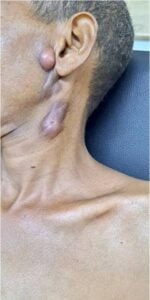
 Scrofula is a type of bacterial infection that causes swollen, inflamed lymph nodes in the neck, usually as a form of extrapulmonary tuberculosis.
Scrofula (mycobacterial cervical lymphadenitis) is a chronic infection of the neck lymph nodes, most commonly caused by *Mycobacterium tuberculosis* or nontuberculous mycobacteria (NTM).
Uncommon in low-TB-burden settings but remains the most frequent form of extrapulmonary TB worldwide; in adults, ~95% of cases are due to *M. tuberculosis*, whereas in children NTM predominates.
It usually follows inhalation of mycobacteria with spread from lungs to cervical nodes, or reactivation of dormant foci; can also arise from contiguous spread.
Tuberculous or NTM infection of cervical lymph nodes; historically called “the king’s evil.”
It presents as a slowly enlarging, often painless, matted cervical mass that may become fluctuant and drain through the skin.
Typical presentation: Subacute (≥2 weeks) unilateral or bilateral cervical lymphadenopathy; nodes are large, often matted, usually painless or mildly tender; overlying skin may become erythematous/violaceous and can form sinus tracts with drainage.
Systemic symptoms are often absent in immunocompetent patients; when present may include low-grade fever, night sweats, weight loss, fatigue; concomitant pulmonary TB occurs in <50% of immunocompetent adults.
Causes
Risk factors: Foreign birth/high TB-prevalence origin, HIV/immunocompromise, prior positive PPD/IGRA, close TB exposure.
Mycobacterium tuberculosis: The bacterium that causes tuberculosis, responsible for most adult cases.
Nontuberculous mycobacteria: Often causes infections in children who have healthy immune systems.
Spread: The bacteria move from the lungs or other sites into the lymph nodes of the neck.
Symptoms-Swelling: Large, painless or slightly tender lumps or matted masses on one or both sides of the neck.
Skin changes: Purplish or discolored skin over the swollen lymph nodes.
Sores: Open, draining skin sores on the neck in severe cases.
Systemic signs: Occasional fever, fatigue, night sweats, and weight loss.
Diagnosis and TreatmentTesting:
Confirmed using a fine-needle aspiration biopsy, tissue biopsy, or tuberculin skin/blood tests.
Medication: Treated with a multi-month course of standard anti-tuberculosis antibiotics, such as isoniazid, rifampin, and ethambutol.
Differential diagnosis: Consider malignancy-lymphoma, metastatic head/neck cancer; bacterial suppurative lymphadenitis, cat-scratch disease (*Bartonella*), toxoplasmosis, sarcoidosis, and other granulomatous diseases—especially in older adults or those with prior oncologic history where scrofula can mimic cancer.
Diagnosis: Chest radiograph to assess for pulmonary TB
TB testing (IGRA or TST)
HIV testing when appropriate.
Microbiology/pathology: Fine-needle aspiration (FNA) or excisional biopsy is central; for AFB smear/culture, mycobacterial PCR/NAAT, and histology.
Nuclear acid amplification (NAAT) results can be variable/not fully reliable as a stand alone rule-out; culture remains important for species ID and susceptibilities.
Neck ultrasound or CT can define extent and guide biopsy but are adjunctive.
Treatment
Management depends on the mycobacterial species and host factors.
If M. tuberculosis (most adult cases):Standard anti-TB therapy.
Common regimen: 2 months of isoniazid + rifampin + pyrazinamide + ethambutol, followed by 4+ months of isoniazid + rifampin (total often 6–9 months; some sources use 9–12 months for lymph node TB).
Monitor for drug toxicity and interactions and involve public health/TB programs as required.
NTM, common in children) regimens differ; macrolide-based therapy (e.g., clarithromycin or azithromycin) plus ethambutol ± rifampin is typical, tailored to species and susceptibilities.
Surgery: Excisional biopsy can be diagnostic and sometimes therapeutic in NTM disease.
In TB lymphadenitis, surgery is reserved for complications (e.g., abscess drainage, persistent sinus, diagnostic uncertainty) and is not first-line.
With appropriate antibiotics, cure rates are high (~89–94%).
Scrofula in the differential for subacute cervical masses—especially in patients with TB risk factors or immunocompromise—and prioritize ruling out active pulmonary TB before invasive procedures.