
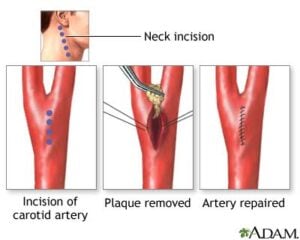
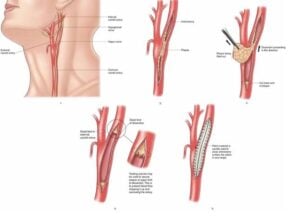
 With carotid artery stenosis carotid endarterectomy is associated with a lower risk of stroke compared to carotid stenting, while stenting carries a lower risk of periprocedural myocardial infarction.
A meta-analysis of 13 randomized controlled trials involving 7,484 patients (80% with symptomatic stenosis) demonstrated that stenting had a 45% higher relative risk of any stroke compared to endarterectomy.
Conversely, stenting was associated with a 57% lower risk of periprocedural myocardial infarction.
The choice between procedures depends ontechnical feasibility, individualized risk-benefit assessment, and patient preference.
For symptomatic carotid stenosis (50-99% lumen stenosis), both procedures provide benefit, with revascularization typically recommended within 2 weeks of symptom onset.
In asymptomatic carotid stenosis (50-99%), stenting—but not endarterectomy—was found superior to medical management alone.
This is an important distinction in the management of asymptomatic disease.
The procedural risk differences between these approaches are particularly pronounced in older patients.
A 2020 Cochrane systematic review of 10 trials involving 5,396 participants with symptomatic carotid stenosis found that stenting was associated with a 70% higher risk of periprocedural death or stroke compared to endarterectomy.
This increased risk was strongly age-dependent: in patients under 70 years, the odds ratio was 1.11, whereas in those 70 years or older, it increased to 2.23.
The excess risk with stenting was primarily driven by minor, non-disabling strokes rather than major strokes.
Beyond the periprocedural period, both procedures demonstrate equivalent long-term efficacy in preventing recurrent stroke.
In a pooled analysis of the four largest trials, the annual risk of postprocedural ipsilateral stroke was 0.6% in both treatment groups.
The CREST trial reported 10-year ipsilateral stroke rates of 6.9% with stenting versus 5.6% with endarterectomy, a difference that was not statistically significant.
Similarly, the ACST-2 trial in asymptomatic patients found 5-year ipsilateral stroke rates of 2.1% with stenting and 1.0% with endarterectomy.
Stenting offers distinct procedural advantages in specific clinical scenarios.
Compared to endarterectomy, stenting reduces the risk of cranial nerve palsy by approximately 90%, eliminates the need for general anesthesia in most cases, and results in fewer access site hematomas
These benefits make stenting particularly suitable for patients with surgically inaccessible lesions, prior neck surgery or radiation, contralateral vocal cord paralysis, or significant medical comorbidities that increase surgical risk.
Restenosis rates are higher following stenting, with moderate or greater restenosis (≥50%) occurring twice as frequently after stenting compared to endarterectomy.
This increased restenosis has not translated into higher rates of late ipsilateral stroke in clinical trials.
Current guidelines from multiple societies recommend endarterectomy as first-line treatment for symptomatic carotid stenosis, particularly in patients 70 years or older.
Stenting is suggested as an alternative in younger patients
For asymptomatic stenosis, endarterectomy is recommended for 60-99% stenosis in patients at increased stroke risk, while stenting is not routinely recommended but may be considered in selected patients unsuitable for surgery.
Carotid endarterectomy (CEA) remains the default revascularization strategy for most patients with carotid artery stenosis, with carotid artery stenting (CAS) reserved for selected high‑surgical‑risk or anatomically favorable patients, especially if younger and treated in high‑volume centers.
Multiple RCT meta‑analyses show higher 30‑day stroke or death with CAS vs CEA, largely due to more non‑disabling ischemic strokes, particularly in patients >70 years.
Periprocedural MI: CEA carries a slightly higher risk of perioperative MI, while CAS has lower MI risk but higher stroke risk; overall major adverse events are typically still lower with CEA.
Long‑term stroke prevention: Beyond the periprocedural window, CAS and CEA are broadly similar in prevention of ipsilateral and disabling stroke up to 5–10 years, when performed in appropriate candidates.
Moderate restenosis (≥50%) and/or occlusion is generally more frequent after CAS in pooled analyses, though severe restenosis (≥70%) and clinically relevant events are often similar.
Cranial nerve injury/wound complications are more common with CEA (neck incision, dissection), and minimal with CAS.
Symptomatic (recent TIA/minor stroke, ≥50–70% stenosis):
CEA is superior for periprocedural safety-lower 30‑day stroke/death, with similar long‑term protection; guidelines generally recommend CEA as first‑line when surgical risk is acceptable.
CAS is considered when CEA risk is high (hostile neck, prior CEA, radiation, severe cardiopulmonary disease) and when operator/institutional CAS outcomes meet guideline thresholds.
Asymptomatic (typically ≥60% stenosis):
Contemporary evidence suggests CEA has equal or better safety and lower stroke rates than CAS in most analyses; both must be weighed against optimized medical therapy and the patient’s life expectancy.
CAS may be used in asymptomatic patients only if peri‑procedural risk is very low and there is a strong anatomic or surgical‑risk rationale.
Typical candidate profiles
Scenario | CEA favored | CAS favored
Age -Older patients, especially >70 years (less peri‑procedural stroke)
Younger patients (<70) with good vascular access, lower embolic risk
Symptomatic ≥50–70% stenosis, acceptable surgical risk
Symptomatic but high surgical/neck risk, if CAS outcomes are excellent
Cardiac/comorbidity profile | Lower cardiac risk, suitable for GA or RA
High cardiac risk where avoiding open surgery/GA is prioritized
Neck anatomy Normal anatomy, no prior neck surgery/radiation
Hostile neck (prior CEA, radiation, high carotid bifurcation), surgically inaccessible lesions
Complication concerns
Accept higher cranial nerve palsy risk, slightly higher MI risk
Accept higher periprocedural stroke risk, low cranial nerve/neck wound risk.
For a typical older, symptomatic patient (e.g., 75‑year‑old with 70% stenosis), CEA is generally preferred due to lower periprocedural stroke/death with comparable long‑term efficacy.
For a younger but high‑surgical‑risk patient with symptomatic stenosis (e.g., prior neck radiation, severe COPD, high carotid bifurcation), CAS in an experienced center is a reasonable alternative.
Choice should incorporate: age, symptom status and timing, stenosis severity, neck and arch anatomy, cardiopulmonary risk, anticipated durability, and institutional/operator outcomes.