 Without treatment, about half of people die at ~4 Gy (within 60 days), and doses above ~6-8 Gy are almost always fatal.
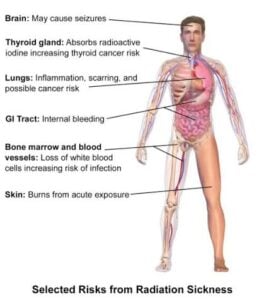
Deaths come from bone marrow failure, then gastrointestinal and neurovascular damage at higher doses.
Delayed (cancer): At low to moderate doses, the main risk is cancer years later.
Radiation-associated mortality therefore spans two distinct contexts: acute, deterministic death from high-dose exposure (acute radiation syndrome, ARS), and delayed, stochastic death from radiation-induced cancer and cardiovascular disease following lower cumulative or whole-body doses.
Risk models estimate roughly a 5% increase in lifetime fatal cancer risk per sievert, assuming risk scales linearly with dose.
At low doses (below ~100 mSv), the effect is too small to measure directly, so it’s estimated by extrapolation.
Real-world numbers:
Chernobyl (1986): 28 acute radiation deaths among plant workers and responders. WHO projected up to ~4,000 eventual cancer deaths among the most exposed groups.
Fukushima (2011):No confirmed acute radiation deaths.
Evacuation-related deaths (stress, disrupted care) were far larger, in the low thousands.
Hiroshima/Nagasaki survivors: The long-term study shows several hundred excess cancer deaths among ~100,000 people followed.
Radon:The biggest everyday source of lethal radiation exposure.
The EPA estimates ~21,000 US lung cancer deaths per year are linked to it, mostly in smokers.
For context, natural background radiation averages ~2.4 mSv per year, and a chest X-ray is ~0.1 mSv.
Are you after a specific angle, like nuclear accidents, medical imaging, radon, or occupational exposure?
Acute mortality (deterministic / ARS-(acute radiation syndrome).
ARS occurs after whole-body or significant partial-body exposure >1 Gy at a high dose rate, producing hematopoietic, gastrointestinal, and cerebrovascular sub-syndromes that evolve through prodromal, latent, manifest-illness, and recovery/death phases.
Hematopoietic ARS (lowest lethal doses) causes bone marrow failure with neutropenia, thrombocytopenia, hemorrhage, and infection; GI-ARS at higher doses causes crypt stem-cell loss and mucosal barrier breakdown, with lethal sepsis and GI bleeding being dominant determinants of death.
At very high doses, neurovascular/CNS injury causes rapid death.
Death in ARS is driven largely by infection/sepsis, amplified by inflammatory cascades.
Human LD50 is generally estimated around 3.5–4.5 Gy without support and higher with supportive care and G-CSF.
Medical countermeasures: G-CSF agents are FDA-approved to increase survival in persons acutely exposed to myelosuppressive radiation doses.
Eleven radiomitigators—mostly G-CSFs—are FDA-approved for ARS; amifostine remains the only approved small-molecule radioprotector.
Delayed mortality
The atomic bomb survivor Life Span Study (LSS) is the foundational dataset all-cause mortality rose with dose, and for solid cancers the excess additive risk increases throughout life with a linear dose-response and no detectable threshold: sex-averaged excess relative risk was 0.42 per Gy for all solid cancer at age 70 after exposure at age 30.
Risk is significantly elevated for most major cancer sites (stomach, lung, liver, colon, breast, esophagus, bladder, ovary); rectum, pancreas, uterus, prostate, and kidney parenchyma did not show significant excess.
Non-cancer/circulatory disease mortality also rises with dose at high doses and possibly low doses (circulatory, respiratory, digestive), though causality is less certain than for cancer.
Modern pooled worker data (INWORKS, ~310,000 nuclear workers) found solid cancer mortality rose ~52% per Gy, suggesting excess mortality per unit dose may exceed protection-guideline estimates derived from the high-dose A-bomb data.
Occupational cohorts consistently show a dose-related excess of leukemia (excluding CLL) at cumulative doses up to ~200 mGy.
Key modifiers of stochastic mortality risk:
Age at exposure: children and those <30 are markedly more sensitive with greater mitotic activity, longer latency to express cancer,
Sex: females have higher risk and a steeper dose-response for solid cancers overall from radiation exposure.
Dose and dose rate: linear risk is graded with cumulative dose.
In radiation oncology, treatment-associated mortality is driven chiefly by late organ toxicity and second malignancies.
Cardiac radiation dose is a notable contributor: in lung cancer patients, higher mean heart dose is associated with increased all-cause mortality, particularly in those without pre-existing coronary disease.
Lifetime mortality modeling from the LSS (accounting for dose estimates, at 0.1 Gy, solid cancer mortality risk ~3.6–3.9% per Gy, leukemia ~0.35–0.41% per Gy, and circulatory disease ~1.6–2.2% per Gy for a UK-type population, with higher risks generally in females.
According to research pilots and flight attendant accumulated an estimated 3 to 6 mSv of cosmic radiation each year. For comparison, a one-way flight across the US resulted in about 0.04 Millet of cosmic radiation exposure, about half the radiation received from a chest x-ray.
Pilots and flight attendant may be an increased risk of radiation exposure due to cosmic raise the encounter while in the sky.
Radiation related cancers include breast, CNS, multiple myeloma, leukemia, lymphoma, thyroid, prostate, melanoma, and non-melanoma skin cancers.
Flight attendant of the highest risk adjusted percentage of deaths from radiation related cancers, followed by pilots both, nearly 7%. In particular air cruise have a higher risk of death from breast, CNS, and plus the cancers as well as melanoma.