 Cataplexy is the sudden, transient loss of voluntary muscle tone (weakness or paralysis) triggered by strong emotions, with fully preserved consciousness.
Cataplexy is a sudden, brief loss of voluntary muscle tone triggered most often by strong emotions, particularly laughter, excitement, surprise, or anger.
Cataplexy is not simply ordinary muscle weakness, a seizure, or fainting.
Emotional triggers and preserved awareness are important diagnostic clues.
Cataplexy is caused by a temporary intrusion of the brain’s REM-sleep-related muscle paralysis into wakefulness.
It is strongly associated with narcolepsy type 1.
Cataplexy is the emotionally triggered, reversible muscle atonia of narcolepsy type 1 that leaves the person fully awake but temporarily powerless.
It is the pathognomonic feature of narcolepsy type 1.
Most often positive emotions (especially laughter), but also excitement, surprise, anger, fear, or stress.
Duration: Typically seconds to a couple of minutes; resolves spontaneously.
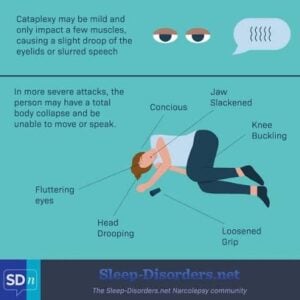
Manifestations: Range from mild/partial (facial sagging or drooping eyelids, jaw drop, slurred speech, head nodding, knee buckling, or dropping objects) to severe/complete (collapse to the ground with inability to move or speak).
Consciousness and awareness remain intact throughout—this distinguishes it from syncope, seizures, or drop attacks.
Frequency: Highly variable—some people experience only rare episodes over a lifetime; others have multiple attacks daily.
Cataplexy reflects the intrusion of REM-sleep muscle atonia into wakefulness.
It is tightly linked to deficiency of the hypothalamic neuropeptide hypocretin (orexin), which normally promotes wakefulness and stabilizes muscle tone via monoaminergic pathways.
Narcolepsy type 1 is defined by excessive daytime sleepiness plus either cataplexy or low CSF hypocretin-1 (<110 pg/mL).
Roughly 60–70% of people with narcolepsy have cataplexy.
Isolated cataplexy without narcolepsy is uncommon; rare secondary causes include certain neurologic disorders (e.g., gelastic cataplexy in Niemann-Pick type C).
Diagnosis is clinical (history of emotion-triggered muscle weakness with preserved awareness), supported by sleep studies (MSLT showing short sleep latency and sleep-onset REM periods) and, when needed, CSF hypocretin measurement or HLA typing (strong association with HLA-DQB1*06:02).
Generally involves evaluation by a sleep-medicine specialist and may include:
Overnight polysomnography can assess sleep and exclude other sleep disorders.
Multiple Sleep Latency Test (MSLT) to measure how quickly a person falls asleep and whether REM sleep occurs unusually early.
Cerebrospinal fluid hypocretin testing in selected cases when the diagnosis remains uncertain.
Treatment:
There is no cure, but effective treatments markedly reduce or eliminate attacks:
Sodium oxybate or other oxybate formulations-Can reduce cataplexy and improve other narcolepsy symptoms.
Sodium oxybate (Xyrem or once-nightly formulations such as Lumryz) — highly effective for both cataplexy and daytime sleepiness.
Pitolisant (H3-receptor antagonist/inverse agonist).
Pitolisant Can reduce cataplexy and daytime sleepiness
Venlafaxine or selected SSRIs, may suppress cataplexy
Antidepressants that suppress REM sleep (SSRIs such as fluoxetine, SNRIs such as venlafaxine, atomoxetine, or tricyclics such as clomipramine) — often used off-label or as adjuncts.
Regular sleep schedule and planned naps, may help manage associated daytime sleepiness
Medication selection requires medical supervision because of potential adverse effects and interactions.
A newer treatment is also available: on August 5, 2026, the FDA approved oveporexton (Orzeyful) for adults with narcolepsy type 1. It acts directly on orexin signaling and targets the underlying biology of the disorder.
Residual cataplexy can persist in a substantial proportion of treated patients and is associated with greater symptom burden.
When to seek medical attention
If muscle weakness is new, occurs without an emotional trigger, or is accompanied by loss of consciousness, seek medical evaluation rather than assuming it is cataplexy.
Sudden one-sided weakness, facial drooping, or difficulty speaking can indicate a stroke and requires emergency assessment.