 A millisievert (mSv) is a unit of ionizing-radiation dose used to express equivalent dose or effective dose—quantities that account for radiation’s biological effects, rather than just the energy absorbed.
A sievert (Sv) measures radiation dose adjusted for its potential biological harm, especially long-term cancer risk.
A gray (Gy), by contrast, measures only how much radiation energy tissue absorbs per kilogram.
One millisievert is one-thousandth of a sievert.
In medical imaging, it usually refers to effective dose, which accounts for the different radiation sensitivities of exposed organs.
Conversions – 1 mSv = 0.001 Sv – 1 mSv = 1,000 microsieverts (µSv) – 1 mSv = 100 millirem (mrem), or 0.1 rem.
The distinction is between absorbed energy and a radiation-protection estimate of biological impact:
Absorbed dose | Gray (Gy), often milligray (mGy) Radiation energy deposited per kilogram of tissue
Equivalent dose | Sievert (Sv), often mSv is Absorbed dose weighted for radiation type
Effective dose | Sievert (Sv), often mSv Additionally accounts for the differing radiation sensitivities of exposed organs
These quantities are related, but mGy and mSv are not generally interchangeable.
Effective dose is useful for comparing exposures and their potential long-term risks; it is not a precise prediction of an individual patient’s cancer risk.
Also, mSv denotes a dose, whereas mSv/hour denotes a dose rate.
A millisievert (mSv) is one-thousandth of a sievert, the unit for biologically effective radiation dose.
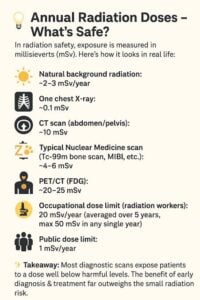
0.01 mSv:** dental X-ray 0.1 mSv:** chest X-ray ~2.4 mSv/year:** average natural background (radon, cosmic rays, soil, food) 7-10 mSv:** abdominal/pelvic CT scan 20 mSv/year:occupational limit for radiation workers (averaged over 5 years) 100 mSv:lowest dose where a cancer increase is statistically detectable, roughly +0.5% lifetime fatal cancer risk
1,000 mSv (1 Sv):mild radiation sickness (nausea, low blood counts); ~5% added lifetime fatal cancer risk
4,000 mSv ~50% mortality within 60 days without treatment 8,000+ mSv: almost always fatal
The key distinction: below ~100 mSv, there’s no proven death toll, only estimated risk based on the linear no-threshold model.
Above ~1,000 mSv, effects are direct and certain.
A single CT scan adds roughly 0.04% to lifetime cancer death risk, far smaller than your baseline risk of about 20%.
Approximate adult effective doses: Chest X-ray 0.1 mSv Natural background radiation in the United States, per year About 3 mSv CT chest 6.1 mSv CT abdomen and pelvis | 7.7 mSv
Imaging doses vary substantially with patient size, equipment, clinical indication, and scanning protocol.
A useful mental anchor: 1 mSv is approximately 10 chest X-rays or four months of typical U.S. natural background radiation.
At diagnostic-imaging doses, the principal concern is a small possible increase in lifetime cancer risk, rather than immediate radiation injury.
Risk estimates at low doses are uncertain.
There is no sharp safe versus dangerous cutoff at 100 mSv.
Radiation protection conservatively assumes that cancer risk increases with cumulative dose, even below levels where the size of the risk can be measured reliably.
The same cumulative dose delivered rapidly versus over many years is not biologically interchangeable; dose rate and exposure pattern matter.
In the United States, the NRC generally limits exposure from regulated activities to:
Members of the public: 1 mSv/year, excluding natural background and the person’s medical exposure.
Adult radiation workers: 50 mSv/year for occupational exposure.
A medically indicated CT exceeding 1 mSv does not violate the public exposure limit.
The relevant medical question is whether the examination’s expected benefit justifies the exposure—not whether it fits within the occupational or public annual limit.