
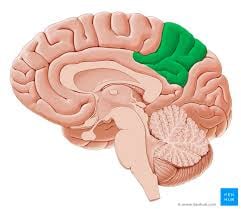
 The precuneus is the portion of the superior parietal lobule on the medial surface of each brain hemisphere.
It is located in front of the cuneus,the upper portion of the occipital lobe.
The precuneus is bounded in front by the marginal branch of the cingulate sulcus, at the rear by the parieto-occipital sulcus, and underneath by the subparietal sulcus.
The precuneus is a region of the brain located in the medial (inner) surface of the parietal lobe.
It sits in the upper rear portion of each cerebral hemisphere, between the two halves of the brain.
The precuneus is involved with episodic memory, visuospatial processing, reflections upon self, and aspects of consciousness.
The location of the precuneus makes it difficult to study, and is rarely subject to isolated injury due to strokes, or trauma such as gunshot wounds.
It is one of the less accurately mapped areas of the whole cortical surface.
It contains three subdivisions.
The precuneus is located on the inside between the two cerebral hemispheres in the rear region between the somatosensory cortex and forward of the cuneus, which contains the visual cortex.
It is above the posterior cingulate.
Sensorimotor Anterior Region
Cognitive/Associative Central Region
Visual Posterior Region
Below the cerebral cortex, the precuneus is connected with the dorsalmost nuclei of the thalamus, including the ventral lateral nucleus, the central and anterior nuclei of the intralaminar nuclear group, and the lateral pulvinar.
Other connections include the claustrum, the dorsolateral caudate nucleus, putamen, the zona incerta, brainstem areas such as the pretectal area, the superior colliculus, the nucleus reticularis tegmenti pontis, and the basis pontis.
The mental imagery concerning the self has been located in the forward part of the precuneus with posterior areas being involved with episodic memory.
The precuneus plays a role in itch sensations and their brain processing.
Functional imaging has linked the precuneus to the processes involved in self-consciousness, such as reflective self-awareness, that involve rating one’s own personality traits compared to those judged of other people.
The precuneus is involved in several important cognitive processes:
Self-referential processing and consciousness – It plays a major role in self-reflection, autobiographical memory retrieval, and aspects of consciousness and self-awareness.
Visuospatial imagery – The precuneus helps with mental imagery and spatial reasoning, allowing you to visualize objects or navigate mentally through remembered spaces.
Episodic memory – It’s crucial for recalling personal experiences and events from your past.
Electrical stimulation of the anterior portion can induce an out of body experience.
The precuneus is involved in memory tasks, such as when people look at images and try to respond based on what they have remembered in regard to verbal questions about their spatial details.
It is involved with the left prefrontal cortex in the recall of episodic memories including past episodes related to the self.
The precuneus is also involved in source memory in which the “source” circumstances of a memory are recalled with the left inferior prefrontal cortex.
Precuneus gets involved in diverse processes such as attention, episodic memory retrieval, working memory and conscious perception.
The precuneus has been suggested to be involved in directing attention in space both when an individual makes movements and when imaging or preparing them.
The precuneus Is involved in motor imagery and shifting attention between motor targets.
It is also involved in motor coordination that requires shifting attention to different spatial locations.
Together the precuneus with the dorsal premotor cortex is involved in visuospatial mental operations.
The premotor area engages in mental operation, and the precuneus aids monitoring the success of that operation in terms of internally represented visual images.
The precuneus’ role in mental imagery may extend to that of modeling other people’s views.
It is activated when a person takes a third-person versus first-person visual point of view.
The precuneus is activated when people make judgments that require understanding whether to act out of empathy and forgiveness.
Precuneus is thought to be related to response inhibition.
Together with the posterior cingulate, the precuneus is pivotal for conscious information processing.
The evidence for this link with consciousness comes from the effects of its disruption in epilepsy, brain lesions and vegetative state.
Cerebral glucose metabolism is at its highest in these two areas during wakefulness but is most reduced in them during anesthesia.
It is one of the areas of the brain most deactivated during slow-wave sleep and rapid eye movement sleep.
Together with the prefrontal cortex, the precuneus, is more activated upon the learning of words briefly flashed when they are supraliminal and so enter consciousness than subliminal, and so do not enter consciousness.
The precuneus is involved in self-referential processing, imagery and memory, and its deactivation is associated with anaesthetic-induced loss of consciousness.
A positive relationship has been found between the volume of grey matter in the right precuneus and the subject’s subjective happiness score.
Mindfulness based interventions correlate with a significant grey matter increase within the precuneus.
The precuneus is more highly developed in human beings than in non-human primates or other animals, has the most complex columnar cortical organization and is among the last regions to myelinate.
The precuneus is a region of the brain located in the medial part of the parietal lobe, sitting between the two cerebral hemispheres.
It’s part of the posterior medial cortex and occupies the area just above the cuneus in the occipital lobe.
The precuneus is a central hub in the default mode network, which is active when your mind is at rest and not focused on the external environment, such as during daydreaming or mind-wandering.
Alterations in precuneus function have been observed in several conditions including Alzheimer’s disease, depression, schizophrenia, and various other neurological and psychiatric disorders.
It’s also one of the brain regions that shows decreased activity during states of reduced consciousness, like deep sleep or anesthesia.
The precuneus can be functionally subdivided into distinct regions along anterior-posterior and dorsal-ventral axes.
The anterior-dorsal precuneus is involved in self-centered mental imagery and bodily awareness, while the posterior-dorsal precuneus supports episodic memory retrieval.
The ventral precuneus is part of the default mode network (DMN) and plays a central role in self-related mental representations during rest.
The precuneus integrates information between internally oriented networks and externally oriented networks, with its subdivisions showing flexible connectivity patterns that modulate based on cognitive demand.
Notably, the precuneus shows selective hypometabolism in altered states of consciousness such as sleep, anesthesia, and vegetative states, suggesting a critical role in the neural correlates of consciousness.
The precuneus is involved in several important functions:
Self-referential processing and self-awareness- thinking about yourself and your mental states
Episodic memory retrieval- recalling personal experiences and events from your past.
Visuospatial processing- mentally manipulating images and navigating space
It is part of the default mode network, which is active during rest and internal thought.