
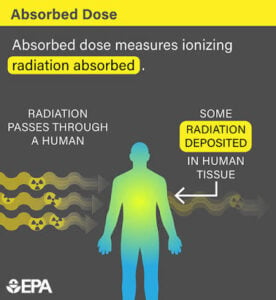
 The **gray** (Gy) measures how much energy radiation deposits in a material, such as body tissue, relative to its mass.
It is the unit of absorbed radiation dose.
1 gray} = 1joule of energy absorbed per kilogram
In simple terms: it tells you how much radiation energy the tissue actually takes up—not just how much radiation is nearby.
Imagine a 1-kilogram piece of tissue: If it absorbs 1 joule of radiation energy, its absorbed dose is 1 Gy. If it absorbs 2 joules, its absorbed dose is 2 Gy. If those same 2 joules are spread evenly through 2 kilograms of tissue, the dose is 1 Gy.
So the gray measures energy concentration, not the total energy delivered to the entire body.
Different types of radiation can cause different biological effects even when they deliver the same dose in grays.
The sievert (Sv) incorporates weighting factors to account for radiation type; effective dose also accounts for the tissues exposed when estimating risk.
Gray describes absorbed energy, whereas sievert is used for radiation-protection estimates of biological impact or risk.
A sievert (Sv) measures radiation dose adjusted for its potential biological harm, especially long-term cancer risk.
A gray (Gy), by contrast, measures only how much radiation energy tissue absorbs per kilogram.
The distinction matters because different types of radiation can have different biological effects even when they deposit the same amount of energy.
How grays become sieverts
There are two related quantities measured in sieverts:
Equivalent dose adjusts the absorbed dose for the type of radiation:
Equivalent dose (Sv) absorbed dose (Gy)
X-rays and gamma rays have a factor of 1; alpha particles have a factor of 20.
Thus, 0.01 Gy to an organ corresponds to an equivalent dose of 0.01 Sv for X-rays, but 0.2 Sv for alpha radiation absorbed in that organ.
Effective dose additionally accounts for which organs were exposed and their relative sensitivity to radiation-induced cancer and hereditary effects.
It combines the weighted organ doses into one radiation-protection estimate. This is the quantity commonly reported in millisieverts when comparing medical imaging exposures.
There is no universal conversion from grays to sieverts: you need to know the radiation type and, for effective dose, the organs exposed.
Even for X-rays, where an organ’s dose in Gy and equivalent dose in Sv are numerically equal, that does not automatically equal the whole-body effective dose.
A millisievert (mSv) is one-thousandth of a sievert.
Think of sieverts as a tool for comparing radiation risks—not a precise prediction of what will happen to an individual.