
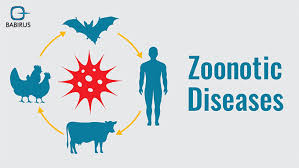
 A zoonosis or zoonotic disease is an infectious disease of humans caused by a pathogen, an infectious agent, such as a virus, bacterium, parasite, fungi, or prion, that can jump from a non-human vertebrate to a human.
When humans infect non-humans, it is called reverse zoonosis or anthroponosis.
Any disease or infection that is primarily naturally transmissible from vertebrate animals to humans or from humans to animals is classified as a zoonosis.
Major modern diseases such as Ebola and salmonellosis are zoonoses.
HIV was a zoonotic disease transmitted to humans in the early part of the 20th century, though it has now evolved into a separate human-only disease.
Human infection with animal influenza viruses is rare, as they do not transmit easily to or among humans.
Avian and swine influenza viruses in particular possess high zoonotic potential, and these occasionally recombine with human strains of the flu and can cause pandemics.
Zoonoses can be caused by a range of disease pathogens such as emergent viruses, bacteria, fungi and parasites; of 1,415 pathogens known to infect humans, 61% are zoonotic.
Most human diseases originated in non-humans; however, only diseases that routinely involve non-human to human transmission, such as rabies, are considered direct zoonoses.
Direct zoonoses diseases is directly transmitted between non-humans and humans through the air (influenza), bites and saliva (rabies), faecal-oral transmission or through contaminated food.
Transmission can also occur via an intermediate species, a vector, which carry the disease pathogen without getting sick.
Dangerous non-human viruses are those that require few mutations to begin replicating themselves in human cells.
The emergence of zoonotic diseases originated with the domestication of animals.
Zoonotic transmission can occur in any context where there is contact with or consumption of animals, animal products, or animal derivatives.
This can occur in a companion pets, economic farming, trade, butchering, and predatory hunting, butchering, or consuming wild game or research context.
Approximately 1.67 million undescribed viruses are thought to exist in mammals and birds, up to half of which are estimated to have the potential to spill over into humans.
Foodborne zoonotic diseases are caused by a variety of pathogens.
The most significant zoonotic pathogens causing foodborne diseases are:
Bacterial pathogens Escherichia coli O157:H7, Campylobacter, Caliciviridae, and Salmonella.
Viral pathogens Hepatitis E: Hepatitis E virus (HEV) is primarily transmitted through pork products, especially in developing countries with limited sanitation.
Norovirus: Often found in contaminated shellfish and fresh produce, norovirus is a leading cause of foodborne illness globally.
Norovirus spreads easily and causes symptoms like vomiting, diarrhea, and stomach pain.
Parasitic pathogens Toxoplasma gondii: This parasite is commonly found in undercooked meat, especially pork and lamb, and can cause toxoplasmosis.
Toxoplasmosis is typically mild, but can be severe in immunocompromised individuals and pregnant women, potentially leading to complications.
Trichinella spp. is transmitted through undercooked pork and wild game, causing trichinellosis.
Symptoms range from mild gastrointestinal distress to severe muscle pain and, in rare cases, can be fatal.
Contact with farm animals can lead to disease in farmers or others that come into contact with infected farm animals.
Glanders primarily affects those who work closely with horses and donkeys.
Contact with cattle can lead to cutaneous anthrax infection.
Inhalation anthrax infection is more common for workers in slaughterhouses, tanneries, and wool mills.
Close contact with sheep who have recently given birth can lead to infection with the bacterium Chlamydia psittaci, causing chlamydiosis as well as increase the risk of Q fever, toxoplasmosis, and listeriosis, in the pregnant or otherwise immunocompromised.
Echinococcosis is caused by a tapeworm, which can spread from infected sheep by food or water contaminated by feces or wool.
Avian influenza is common in chickens, and, while it is rare in humans, the main public health worry is that a strain of avian influenza will recombine with a human influenza virus and cause a pandemic like the 1918 Spanish flu.
Cattle are an important reservoir of cryptosporidiosis, which mainly affects the immunocompromised.
In Western countries, hepatitis E burden is largely dependent on exposure to animal products, and pork is a significant source of infection, in this respect.
The human coronavirus OC43, the main cause of the common cold, can use the pig as a zoonotic reservoir, constantly reinfecting the human population.
Veterinarians are exposed to unique occupational hazards when it comes to zoonotic disease.
The increase in zoonotic pandemics is directly attributable to destruction of nature and the increased global demand for meat and that the industrial farming of pigs and chickens in particular will be a primary risk factor for the spillover of zoonotic diseases in the future.
The wildlife trade may increase spillover risk because it directly increases the number of interactions across animal species.
Zoonotic disease emergence is demonstrably linked to the consumption of wildlife meat, exacerbated by human encroachment into natural habitats and amplified by the unsanitary conditions of wildlife markets.
These markets, where diverse species converge, facilitate the mixing and transmission of pathogens, including those responsible for outbreaks of HIV-1, Ebola, and mpox, and the COVID-19 pandemic.
Small mammals often harbor zoonotic bacteria and viruses.
Insect vectors: African sleeping sickness Dirofilariasis Eastern equine encephalitis Japanese encephalitis Saint Louis encephalitis Scrub typhus Tularemia Venezuelan equine encephalitis West Nile fever Western equine encephalitis Zika fever
Pets
Pets can transmit a number of diseases.
Dogs and cats can transmit rabies.
Pets can also transmit ringworm and Giardia, which are endemic in both animal and human populations.
Toxoplasmosis is a common infection of cats; in humans it is a mild disease although it can be dangerous to pregnant women.
Dirofilariasis is caused by Dirofilaria immitis is transferred through mosquitoes infected by mammals like dogs and cats.
Cat-scratch disease is caused by Bartonella henselae and Bartonella quintana, which are transmitted by fleas that are endemic to cats.
Toxocariasis is the infection of humans by any of species of roundworm, including species specific to dogs (Toxocara canis) or cats (Toxocara cati).
Cryptosporidiosis can be spread to humans from pet lizards, such as the leopard gecko.
Encephalitozoon cuniculi is a microsporidial parasite carried by many mammals, including rabbits.
Encephalitozoon cuniculi is an important opportunistic pathogen in people immunocompromised by HIV/AIDS, organ transplantation, or CD4+ T-lymphocyte deficiency.
Pets may also serve as a reservoir of viral disease and contribute to the chronic presence of certain viral diseases in the human population.
Approximately 20% of domestic dogs, cats, and horses carry anti-hepatitis E virus antibodies and thus these animals probably contribute to human hepatitis E burden.
Outbreaks of zoonoses have been traced to human interaction with, and exposure to, other animals at fairs, live animal markets, petting zoos, and other settings.
Transmission of zoonotic diseases, those leaping from animals to humans, can occur through various routes: direct physical contact, airborne droplets or particles, bites or vector transport by insects, oral ingestion, or even contact with contaminated environments.
Wildlife activities like hunting and trade bring humans closer to dangerous zoonotic pathogens, threatening global health.
Hunting and consuming wild animal meat in regions like Africa can expose people to infectious diseases due to the types of animals involved, like bats and primates.
Commonly used preservation methods like smoking or drying aren’t enough to eliminate these risks.
This practice is intricately linked to numerous emerging infectious diseases like Ebola, HIV, and SARS.
Zoonotic spillover linked to wildmeat consumption has been reported across all continents.
Zoonotic diseases are increasingly linked to environmental change and human behavior.
The disruption of forests driven by logging, mining, road building through remote places, rapid urbanization, and population growth is bringing people into closer contact with animal species they may never have been near before.
Increased virus spillover events from animals to humans can be linked to biodiversity loss and environmental degradation, as humans further encroach on wildlands to engage in agriculture, hunting, and resource extraction they become exposed to pathogens which normally would remain in these areas.
Anthropogenic destruction of ecosystems for the purpose of expanding agriculture and human settlements reduces biodiversity and allows for smaller animals such as bats and rats, which are more adaptable to human pressures and also carry the most zoonotic diseases, to proliferate.
There is a link between climate change and zoonosis.
The link between climate change and the epidemic emergence in the has been caused by a massive migration of species to new areas, and consequently contact between species which do not normally come in contact with one another.
Zoonotic diseases contribute significantly to the burdened public health system as vulnerable groups such the elderly, children, childbearing women and immune-compromised individuals are at risk.
Climate change, urbanization, animal migration and trade, travel and tourism, vector biology, anthropogenic factors, and natural factors have greatly influenced the emergence, re-emergence, distribution, and patterns of zoonoses.
Secondary transmission encompasses a category of diseases of animal origin in which the actual transmission to humans is a rare event but, once it has occurred, human-to-human transmission maintains the infection cycle for some period of time.
Examples include human immunodeficiency virus (HIV)/acquired immune deficiency syndrome (AIDS), certain influenza A strains, Ebola virus and severe acute respiratory syndrome (SARS).
Ebola is spread by direct transmission to humans from handling bushmeat and contact with infected bats or close contact with infected animals, including chimpanzees, fruit bats, and forest antelope.
Secondary transmission also occurs from human to human by direct contact with blood, bodily fluids, or skin of patients with or who died of Ebola virus disease.
For many human diseases, the human is actually better viewed as an accidental or incidental victim and a dead-end host: rabies, anthrax, tularemia, and West Nile fever.
Thus, much of human exposure to infectious disease has been zoonotic.
Many diseases, even epidemic ones, have zoonotic origin and measles, smallpox, influenza, HIV, and diphtheria are particular examples.
Various forms of the common cold and tuberculosis also are adaptations of strains originating in other species.
Zoonoses are of interest because they are often previously unrecognized diseases or have increased virulence in populations lacking immunity.
Bubonic plague is a zoonotic disease, as are salmonellosis, Rocky Mountain spotted fever, and Lyme disease.
A major factor contributing to the appearance of new zoonotic pathogens in human populations is increased contact between humans and wildlife.
This can be caused either by encroachment of human activity into wilderness areas or by movement of wild animals into areas of human activity.
In recent times avian influenza and West Nile virus have spilled over into human populations probably due to interactions between the carrier host and domestic animals.
Highly mobile animals, such as bats and birds, may present a greater risk of zoonotic transmission than other animals due to the ease with which they can move into areas of human habitation.