
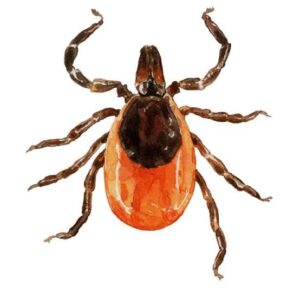
 Ticks are larger arachnids closely related to mites, but they’re exclusively parasitic and feed on blood.
Ticks are not insects—they’re more closely related to spiders and mites belonging to the order Ixodida.
They’re external parasites that feed on the blood of mammals, birds, reptiles, and sometimes amphibians.
Adult ticks are typically 3–5 mm long when unfed but can swell significantly when engorged.
Unlike most mites, ticks are easily visible to the naked eye, especially when engorged with blood.
Ticks range from about 3mm to over 1cm in length depending on species and feeding state.
Like mites, they have eight legs as adults,but six as larvae.
Their bodies are designed for blood-feeding, with specialized mouthparts that anchor into skin and can remain attached for days while feeding.
There are two main families of ticks:
Hard ticks (Ixodidae) have a hard shield on their back and feed for several days.
Hard tick group includes deer ticks, dog ticks, and lone star ticks.
Hard ticks (Ixodidae) are the most common disease vectors.
Soft ticks (Argasidae) lack the hard shield and typically feed for shorter periods, often at night.
Soft ticks (Argasidae): Lack the shield, have leathery bodies, and usually feed briefly.
Ticks go through four life stages: egg, larva with six legs, nymph with eight legs, and adult.
Each active stage requires a blood meal to progress to the next.
Depending on the species, they may feed on the same host or different hosts at each stage.
Some ticks can survive for months or even years between meals.
Ticks live in grassy, brushy, or wooded areas.
Ticks climbs onto grass or low vegetation and grabbing onto passing hosts as they don’t jump or fly.
Ticks don’t jump or fly but instead wait on vegetation with their front legs extended, grabbing onto passing animals or people.
They’re found worldwide but are most abundant in warm, humid climates.
Ticks can transmit serious diseases including Lyme disease, Rocky Mountain spotted fever, ehrlichiosis, anaplasmosis, babesiosis, and tick-borne encephalitis.
Different tick species carry different pathogens, and disease risk varies by geographic region.
Preventing tick bites involves wearing protective clothing, using repellents (like DEET or permethrin), staying on trails, and doing thorough tick checks after being outdoors.
Ticks should be removed promptly using fine-tipped tweezers, grasping close to the skin and pulling straight up with steady pressure.
The sooner a tick is removed, the lower the risk of disease transmission.
Ticks have a four-stage life cycle: egg → larva (six legs) → nymph (eight legs) → adult (eight legs).
Brown dog tick — Often on dogs, reddish-brown, rarely bites humans but can carry diseases for pets.
Lone star tick — Aggressive, white spot on females, can transmit ehrlichiosis, STARI (Southern Tick-Associated Rash Illness), and cause alpha-gal syndrome (red meat allergy).
American dog tick — Colorful with gray/white markings, can transmit Rocky Mountain spotted fever.
Blacklegged tick (deer tick) — Smaller, transmits Lyme disease.
Ticks can transmit serious diseases, including Lyme disease, Rocky Mountain spotted fever, ehrlichiosis, anaplasmosis, babesiosis, and others.
A tick bite often looks like a small red spot or bump, sometimes with a bull’s-eye rash (for Lyme) or other reactions.