
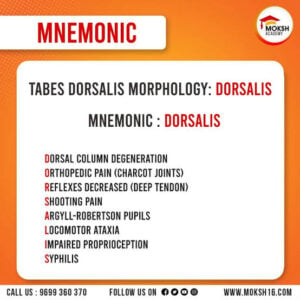
 Tabes dorsalis is a rare, late-stage complication of untreated syphilis that slowly damages the spinal cord and peripheral nerves.
Tabes dorsalis is a rare, late-stage complication of untreated syphilis that slowly damages the spinal cord and peripheral nerves.
It is a form of neurosyphilis—an infection of the central nervous system.
It is caused by Treponema pallidum, the bacterium that causes syphilis.
Symptoms usually appear 15 to 30 years after the initial, untreated sexual infection.
The bacteria cause slow decay/demyelination in the back part of the spinal cord, called the dorsal columns, which normally carry position and touch signals to the brain.
Lightning Pains: Sudden, sharp, stabbing pains in the legs, back, or face that last for seconds or days.
Unsteady Walk: Loss of coordination and a wide-legged, foot-slapping gait, sensory ataxia.
Loss of Senses: Inability to feel vibrations, joint positions, or deep pain, such as in the Achilles tendon).
Reflex Loss: Deep tendon reflexes, like the knee-jerk reaction, disappear.
Eye Changes: Small pupils that react to near vision but do not constrict when exposed to bright light- Argyll Robertson pupils).
Other Issues: Bladder control problems, muscle weakness, and joint damage (Charcot joints).
Treatment Antibiotics: High-dose intravenous penicillin is the main treatment to kill the remaining bacteria.
Pain Management: to help control sharp nerve pain.
Physical Therapy: Balance exercises help patients cope with coordination loss.
Treatment stops the infection and prevents further damage, but it cannot repair nerve fibers that are already destroyed.