
 Bacteriophages are viruses that can infect and kill bacteria.
Bacteriophages are viruses that specifically infect and replicate within bacteria-—not human cells.
They are the most abundant biological entities on Earth, estimated at ~10³¹ particles, outnumbering bacteria roughly 10-fold, and are found in virtually every environment where bacteria exist. 
Phages are ubiquitous in nature and inject their genetic material into their target bacteria reprograming them to manufacture more of the virus.
Their host range is often narrow, targeting a particular bacterial species or even specific strains.
They are abundant in the environment and are normal components of the human microbiome.
The infected bacteria ultimately break open and die, spilling the phases to continue their work.
Basic Structure
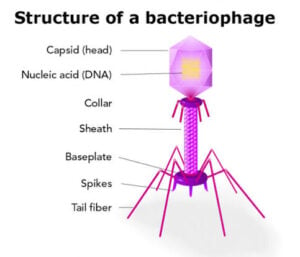
Most phages consist of: Genetic material: DNA or RNA (single- or double-stranded), packaged inside a protein capsid.
Phages contain a DNA or RNA genome enclosed in a protein capsid; many have tails that recognize bacterial surface receptors and deliver the viral genome into the cell.
Capsid: Usually icosahedral (polyhedral head).
Tail (in many tailed phages, order Caudovirales): have a contractile or non-contractile structure used to attach to the bacterial surface and inject nucleic acid.
Some phages are tailless (e.g., filamentous or icosahedral only).
Classic examples include the T-even phages (T2, T4, T6) of E. coli, which have an icosahedral head, contractile tail, and base plate with tail fibers.
Their defining feature is extreme host specificity—most phages infect only a single bacterial species or even particular strains, determined by recognition of specific surface receptors (lipopolysaccharides, teichoic acids, proteins, pili, or flagella).
As a targeted antibacterial against multidrug-resistant organisms, it sparred the commensal microbiome. 
Most characterized phages are double-stranded DNA tailed phages, consisting of a capsid (head) enclosing the genome, attached to a tail that recognizes and binds the bacterial surface. 
Genomes vary widely—from single/double-stranded DNA or RNA, and from <5 kbp to >280 kbp—and morphology ranges from tailed isometric heads to tailless and filamentous forms. 
Typical size is ~20–200 nm. 
Lifecycle Infection begins with attachment of the tail tip to a receptor, followed by injection of the genome into the cytoplasm while the capsid remains outside. 
Phages then follow one of two principal pathways:
Lytic cycle by virulent phages): The phage hijacks host machinery to replicate its genome, assemble new virions, and lyse the cell.
It releases progeny (often from ~12 to tens of thousands per cell) that infect new hosts.
Lysis in dsDNA phages is coordinated by holins, which breach the inner membrane, and endolysins, which degrade peptidoglycan, with additional proteins fusing the membranes in gram-negative bacteria. 
Lysogenic cycle for temperate phages: The genome integrates into the host chromosome or persists as a plasmid-like prophage, replicating passively.
The phage redirects bacterial machinery to produce new viruses, then lyses the bacterium and releases progeny.
Bacterial killing; the preferred mechanism for phage therapy.
A temperate phage persists as a prophage integrated into the bacterial chromosome or maintained outside it, replicating with the host.
It may subsequently enter a lytic cycle.
Can alter bacterial characteristics and contribute to gene transfer.
Lytic phages are being investigated to treat bacterial infections, especially those resistant to antibiotics: may allow targeting of a pathogen while limiting disruption of other microbiota.
A phage must be matched to the infecting bacterial strain.
Phage therapy remains an emerging rather than universally established treatment.
Phages can also transfer genetic material between bacteria, including genes related to toxins or antibiotic resistance, and thereby influence bacterial pathogenicity and evolution.
Phages are used in food-safety and biocontrol applications—for example, targeting bacterial contamination on foods or processing surfaces.
Bacteriophages are viruses that specifically infect and replicate within bacteria (and archaea).
Life Cycles
Phages follow two main reproductive strategies: Lytic cycle (virulent phages): Adsorption → injection of genome → hijacking of host machinery → replication of phage DNA/RNA and synthesis of proteins → assembly of new virions → lysis of the host cell, releasing progeny phages.
Rapid and destructive to the bacterium.
Lysogenic cycle (temperate phages):
The phage genome integrates into the bacterial chromosome (as a prophage) or persists as a plasmid.
It replicates passively with the host until induction (e.g., by stress such as UV or DNA damage), after which it enters the lytic cycle.
Example: Lambda phage (λ) of E. coli.
Some phages can also exhibit chronic infection (continuous release without immediate lysis, common in filamentous phages such as M13).
Major regulators of bacterial populations in oceans, soil, and the human microbiome.
Drive bacterial evolution through predation pressure and horizontal gene transfer.
Contribute to nutrient cycling by lysing bacteria and releasing organic matter.
Applications
Phage therapy: Use of lytic phages to treat bacterial infections, especially antibiotic-resistant ones (renewed interest amid the antimicrobial-resistance crisis; approved or used in some countries for specific indications).
Biotechnology & research:
Phage display for antibody/peptide engineering.
Vectors for gene delivery or cloning.
CRISPR-Cas systems originated as bacterial defenses against phages.
Diagnostics & food safety: Detection of bacterial pathogens; biocontrol agents against foodborne bacteria.
Synthetic biology: Engineered phages for targeted antibacterial activity or delivery of payloads.
High host specificity (often strain-level) can limit breadth but also reduces off-target effects.
Bacteria can evolve resistance (receptor mutation, CRISPR, restriction-modification systems).
Regulatory, manufacturing, and pharmacokinetic issues for therapeutic use.
Safety: Most therapeutic candidates are strictly lytic and free of toxin or antibiotic-resistance genes.
Unlike antibiotics, phages may be able to dissolve biofilms and clear, quiescent intercellular reservoir of bacteria and dormant colonies that can re-emerge and cause another UTI.
Phages will continue to multiply for however long the bacteria remain, giving them more time to infiltrate hard to reach spots.
Bacteriophages are more targeted than antibiotics and as antibiotics killed indiscriminately, they take out beneficial microbes, along with pathogens, each phase targets, a specific bacterial species, and sometimes specific strains, which helps to keep the microbiome balanced.