
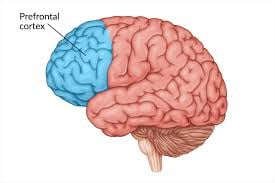
Brodmann areas, 8, 9, 10, 11, 12, 13, 14, 24, 25, 32, 44, 45, 46, and 47 are all in the prefrontal cortex.
The prefrontal cortex (PFC) covers the front part of the frontal lobe of the brain, an nd is associated with the cortex in the frontal lobe.
The PFC contains the Brodmann areas BA8, BA9, BA10, BA11, BA12, BA13, BA14, BA24, BA25, BA32, BA44, BA45, BA46, and BA47.
The PFC region is involved in a wide range of higher-order cognitive functions, including speech formation (Broca’s area), gaze (frontal eye fields), working memory (dorsolateral prefrontal cortex), and risk processing (ventromedial prefrontal cortex).
PFCs basic activity is the orchestration of thoughts and actions in accordance with internal goals.
There is an integral link between a person’s will to live, personality, and the functions of the prefrontal cortex.
PFC is implicated in executive functions, such as planning, decision making, working memory, personality expression, moderating social behavior and controlling certain aspects of speech and language.
Executive function relates to abilities to differentiate among conflicting thoughts, determine good and bad, better and best, same and different, future consequences of current activities, working toward a defined goal, prediction of outcomes, expectation based on actions, and social control.
The prefrontal cortex is highly interconnected with much of the brain, including extensive connections with other cortical, subcortical and brain stem areas.
The dorsal prefrontal cortex is especially interconnected with brain regions involved with attention, cognition and action.
The ventral prefrontal cortex interconnects with brain regions involved with emotion.
The prefrontal cortex also receives inputs from the brainstem arousal systems. and its function is particularly dependent on its neurochemical environment.
The interplay between the prefrontal cortex and socioemotional system of the brain is relevant for adolescent development.
The medial prefrontal cortex has been implicated in the generation of slow-wave sleep (SWS), and prefrontal atrophy has been linked to decreases in SWS.
Prefrontal atrophy occurs naturally as individuals age.
Older adults experience impairments in memory consolidation as their medial prefrontal cortices degrade.
In older adults, instead of being transferred and stored in the neocortex during SWS, memories start to remain in the hippocampus where they were encoded, as evidenced by increased hippocampal activation compared to younger adults during recall tasks, when subjects learned word associations, slept, and then were asked to recall the learned words.
The ventrolateral prefrontal cortex (VLPFC) has been implicated in various aspects of speech production and language comprehension.
The VLPFC is connected to various regions of the brain including the lateral and medial temporal lobe, the superior temporal cortex, the infertemporal cortex, the perirhinal cortex, and the parahippoccampal cortex.
These brain areas are implicated in memory retrieval and consolidation, language processing, and association of emotions.
These connections allow the VLPFC to mediate explicit and implicit memory retrieval and integrate it with language stimulus to help plan coherent speech.
Choosing the correct words and staying on topic during conversation come from the ventrolateral prefrontal cortex .
The prefrontal cortex is presumed to act as a high-level gating or filtering mechanism that enhances goal-directed activations and inhibits irrelevant activations.
It enables executive control at various levels of processing, including selecting, maintaining, updating, and rerouting activations.
It has also been used to explain emotional regulation.
Cognitive control stems from the active maintenance of patterns of activity in the prefrontal cortex that represents goals and means to achieve them.
It provide bias signals to other brain structures whose net effect is to guide the flow of activity along neural pathways that establish the proper mappings between inputs, internal states, and outputs needed to perform a given task.
The prefrontal cortex guides the inputs and connections, which allows for cognitive control of our actions.
The prefrontal cortex is of significant importance when top-down processing is needed, when behavior is guided by internal states or intentions.
fMRI have shown that the medial prefrontal cortex (mPFC), specifically the anterior medial prefrontal cortex (amPFC), may modulate mimicry behavior.
A larger prefrontal cortex volume and greater PFC cortical thickness were associated with better executive performance.
The prefrontal cortex is that it serves as a store of short-term memory.
Both locations served as potential targets of a saccadic eye movement.
Although the task made intensive demands on short-term memory, the largest proportion of prefrontal neurons represented attended locations, not remembered ones.
These findings showed that short-term memory functions cannot account for all, or even most, delay-period activity in the part of the prefrontal cortex explored.
Areas of the prefrontal cortex have been implicated in functions regarding speech production, language comprehension, and response planning before speaking.
Cognitive neuroscience has shown that the left ventrolateral prefrontal cortex is vital in the processing of words and sentences.
The right prefrontal cortex has been found to be responsible for coordinating the retrieval of explicit memory for use in speech, whereas the deactivation of the left is responsible for mediating implicit memory retrieval to be used in verb generation.
Broca’s Area is widely considered the output area of the language production pathway in the brain, as opposed to Wernicke’s area in the medial temporal lobe, which is seen as the language input area.
Broca’s Area has been shown to be implicated for the retrieval of relevant semantic knowledge to be used in conversation/speech.
Brain imaging systems have been used to determine brain region volumes and nerve linkages.
Studies have indicated that reduced volume and interconnections of the frontal lobes with other brain regions is observed in patients diagnosed with mental disorders; those subjected to repeated stress, those who excessively consume sexually explicit materials, suicidal, criminal, sociopaths, and those affected by lead poisoning.
Some of the human abilities to feel guilt or remorse, and to interpret reality, are dependent on a well-functioning prefrontal cortex.
The advanced neurocircuitry and self-regulatory function of the human prefrontal cortex is also associated with the higher sentience and sapience.
It is theorized that, as the brain has tripled in size over five million years of human evolution, the prefrontal cortex has increased in size sixfold.
The left and right halves of the prefrontal cortex, which is divided by the medial longitudinal fissure, appears to become more interconnected in response to consistent aerobic exercise.
Marked improvements in prefrontal and hippocampal gray matter volume occur in healthy adults that engage in medium intensity exercise for several months.
The prefrontal cortex of chronic alcoholics has been shown to be vulnerable to oxidative DNA damage and neuronal cell death.
The prefrontal cortex controls the mental option to delay immediate gratification for a better or more rewarding longer-term gratification result.