
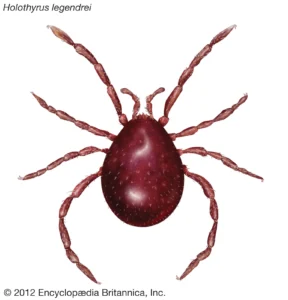
 Mites are microscopic arachnids, related to spiders and ticks.
They are found in almost every habitat and on many plants and animals.
Despite being largely invisible to the naked eye, they’re remarkably important ecologically and can significantly impact human life.
Most are harmless or even ecologically useful, but some cause disease, allergy, or infestation in humans, animals, and crops.
While many mites are harmless or even beneficial, some cause problems.
Mites are tiny arthropods in the class Arachnida, usually under 1 mm in length, with four pairs of legs as adults and a fused body without obvious segmentation.
They belong mainly to two large orders, Acariformes and Parasitiformes, and include ticks as a closely related group.
Mites occupy soil, leaf litter, fresh and salt water, stored products, animal nests, and the skin or respiratory tract of animals, including humans.
Many species act as decomposers or predators of other small arthropods, while others live on plants and can become agricultural pests or form galls.
Agricultural mites can devastate crops.
Parasitic mites cause diseases in humans and animals.
However, predatory mites are also used in biological pest control.
Human-relevant groups include scabies mites (*Sarcoptes scabiei*), itch/“grain” mites (*Pyemotes* spp.), chiggers (*Trombicula* spp.), bird and rodent mites, and house dust mites (*Dermatophagoides* spp.).
Scabies mites burrow into the superficial skin, creating short tunnels where they lay eggs and cause intense pruritus; the entire life cycle occurs on the human host.
Mites can cause pruritic papular eruptions, dermatitis, and in the case of scabies, characteristic burrows and widespread eczematous changes from hypersensitivity.
Dust mites are a major source of indoor allergens, contributing to allergic rhinitis and asthma via fecal particles and body fragments that become airborne and inhaled.
In animals, mites cause mange in dogs and other species, and *Varroa destructor* is a key ectoparasite driving honey bee colony losses.
Some plant-feeding mites, such as spider mites and red mites, can cause substantial damage in agriculture and horticulture by sucking plant juices from leaves and stems.
Mites are typically microscopic to barely visible, usually measuring 0.1 to 2 millimeters long.
Like all arachnids, adult mites have eight legs.
They have adapted to nearly every habitat on Earth, from deep oceans to mountaintops, and from Antarctic ice to desert sand.
There are over 50,000 described species of mites, with scientists estimating the actual number could be several times higher.
They play various roles in ecosystems: many are decomposers that break down organic matter, some are predators of other tiny organisms, others are parasites, and some form beneficial relationships with other species.
Dust mites live in bedding and upholstery, feeding on dead skin cells.
Spider mites are garden pests that damage plants.
Chiggers are larval mites that bite humans.
Demodex mites live in human hair follicles and almost everyone has them.
Scabies mites burrow into skin causing intense itching.
There are also many mites that affect pets, livestock, and stored foods.