
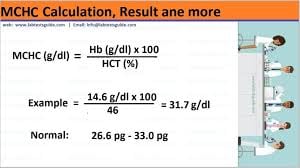
 Mean Corpuscular Hemoglobin Concentration (MCHC) is a measure of the average concentration of hemoglobin inside a single red blood cell relative to its volume.
It is one of the standard red blood cell indices provided in a Complete Blood Count.
MCHC helps identify and classify different types of anemia.
Normal Range: 32 to 36 grams per deciliter (g/d.
Low MCHC (Hypochromia): Below 32 g/dL.
Common Causes: Iron deficiency anemia is the most frequent cause. Other causes include thalassemia and chronic diseases.
Visual Appearance: Red blood cells appear paler than normal under a microscope because they are underfilled with hemoglobin.
High MCHC (Hyperchromia): Above 36 g/dL. Common Causes: High levels are rare but can indicate hereditary spherocytosis, hereditary xerocytosis where cells are spherical and dense or autoimmune hemolytic anemia.
Severe dehydration can falsely elevate MCHC.
MCHC is not measured directly; it is calculated using the total hemoglobin (Hgb) and the hematocrit (Hct) — the percentage of whole blood made up of red cells.
MCHC vs. MCH It is often confused with MCH (Mean Corpuscular Hemoglobin), but there is a distinct difference:
MCH: The average amount (weight) of hemoglobin per cell, measured in picograms.
MCHC: The average concentration of hemoglobin per cell, which accounts for the cell’s size.
A cell could have a high MCH (more hemoglobin) but a normal MCHC if the cell itself is also larger than normal.