
 Mean arterial pressure (MAP) is the average pressure in a person’s arteries during one complete cardiac cycle.
It is a better indicator of adequate blood flow (perfusion) to vital organs and tissues than systolic blood pressure alone.
The primary function of MAP is to ensure sufficient pressure to drive blood flow to all of the body’s tissues, keeping them functional.
Normal Range: A normal MAP is typically considered to be between 70 and 110 mm Hg.
Generally, a MAP of at least 60 mm Hg is needed to maintain adequate perfusion of vital organs like the brain, heart, and kidneys.
Medical guidelines often recommend maintaining a MAP of at least 65 mm Hg to prevent organ failure.
A MAP below 60 mm Hg can lead to inadequate blood supply and potential organ failure.
A MAP above 110 mm Hg suggests the heart is working excessively hard, which can lead to cardiovascular stress, blood clots, or damage to the heart muscle and arteries over time.
MAP can be measured directly through an invasive arterial line in a hospital setting for critical patients.
More commonly, it is estimated using non-invasive blood pressure (NIBP) cuffs, which often automatically provide the MAP reading.
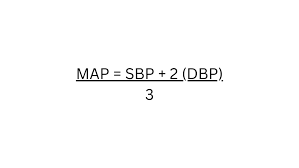
It can also be estimated using a formula based on an individual’s systolic blood pressure and diastolic blood pressure (DBP+SP X2 /3).
The formula gives more weight to the diastolic pressure because the heart spends approximately two-thirds of the cardiac cycle in diastole, the relaxation phase between beats.
A blood pressure of 120/80 mm Hg would have a MAP of approximately 93 mm Hg:\((120+(2\times 80))/3=(120+160)/3=280/3\approx 93\text{\ mm\ Hg}\).