
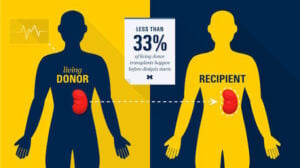
 A living donor kidney transplant is when someone gives one of their kidneys to a person with kidney failure, rather than the kidney coming from a deceased donor.
Most people have two healthy kidneys but only need one to live a normal life.
Donors go through extensive medical and psychological screening to confirm they’re healthy enough and doing it voluntarily.
Surgery can be scheduled rather than waiting on a list
Recipient can get transplanted before needing dialysis, called preemptive transplant.
Up to 25% of kidneys donated are from living donors.
Up to a third of renal transplants are preemptive.
If donor and recipient aren’t a match: Paired exchange programs can match incompatible pairs with other incompatible pairs, or with chains of donors, so everyone still gets a compatible kidney
For the donor surgery is usually laparoscopic (minimally invasive), with a hospital stay of a few days.
Most donors recover within 4–6 weeks.
Long-term, kidney donors generally have normal life expectancy and kidney function, though there’s a small increased lifetime risk of kidney issues that transplant centers monitor for
Donors go through extensive medical and psychological screening to confirm they’re healthy enough and doing it voluntarily.
Can be a family member, spouse, friend, or even a stranger (altruistic/non-directed donation).
Kidneys typically last longer (often 15–20+ years vs. 10–15 for deceased donor)