
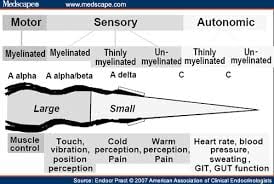
 The primary difference between large and small nerve fibers lies in their physical structure, the functions they control, and the symptoms they produce when damaged.
Large nerve fibers and small nerve fibers differ fundamentally in their structure, conduction velocity, and functional roles in the peripheral nervous system.
Large nerve fibers are heavily myelinated, while small nerve fibers are either thinly myelinated (Aδ-fibers) or unmyelinated (C-fibers).
Small Nerve Fibers
Structure Thinner (0.2–5 μm), unmyelinated (C-fibers) or thinly myelinated (A-delta).
Primary Job Transmit pain, temperature, itch, and autonomic (involuntary) signals.
Speed Slow conduction (0.5–30 m/s).
Neuropathy Symptoms Burning pain, tingling, “electric shocks,” and temperature sensitivity.
Large nerve fibers
Thicker (5–20 μm), heavily myelinated (A-alpha and A-beta).
Primary job Control muscle movement, balance, touch, vibration, and proprioception (body position).
Small fibers conduct much more slowly—Aδ-fibers at 5-30 m/s and C-fibers at 0.5-2 m/s.This velocity difference correlates directly with fiber diameter.
Large fibers conduct signals rapidly (up to 120 m/s for the largest Aα fibers), while small fibers conduct much more slowly—Aδ-fibers at 5-30 m/s and C-fibers at 0.5-2 m/s.
This velocity difference correlates directly with fiber diameter.
Weakness, numbness, loss of balance, and reduced reflexes.
Neuropathy Comparison Small Fiber Neuropathy (SFN): Often presents with “positive” symptoms like chronic burning pain.
It frequently affects autonomic functions, leading to issues with heart rate, blood pressure, or sweating.
A key challenge is that SFN is often undetectable on standard Electromyography (EMG) or nerve conduction studies, often requiring a skin biopsy for diagnosis.
Large Fiber Neuropathy (LFN): Typically manifests as “negative” symptoms like loss of sensation.
Patients may experience difficulty walking (ataxia) or muscle wasting.
Unlike SFN, LFN is usually easily diagnosed via standard nerve conduction tests.
Mixed Fiber Neuropathy: Many conditions, such as diabetes, can affect both fiber types simultaneously or progress from small to large fiber damage over time.
Large fibers are faster because they are wrapped in myelin, a fatty insulation that allows signals to jump along the nerve.
The myelin sheath in large fibers enables saltatory conduction, allowing rapid signal transmission with lower energy requirements.
Small fibers lack this thick insulation, making them more primitive but also more susceptible to certain types of metabolic or toxic damage.
Small fibers’ minimal or absent myelin necessitates panaxonal ion-channel deployment, making them metabolically vulnerable due to their high surface-to-volume ratio.
Large fibers mediate proprioception, vibration sense, and motor function, while small fibers transmit pain, temperature, and itch sensations.
In the autonomic nervous system, small fibers control sudomotor, thermoregulatory, cardiovascular, gastrointestinal, and urogenital functions.
All motor axons (except gamma efferents to muscle spindles) are large fibers, so weakness or atrophy indicates large fiber involvement.
Large fiber neuropathy presents with loss of reflexes, impaired vibration/proprioception, and sensory ataxia.
Small fiber neuropathy manifests as burning pain, reduced pinprick and temperature sensation, and autonomic dysfunction, typically with preserved reflexes and strength.
Standard nerve conduction studies detect large fiber dysfunction but cannot assess small fibers, requiring specialized testing like skin biopsy or quantitative sensory testing.