
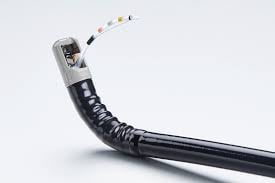
 Duodenoscopes are specialized flexible endoscopes used in gastroenterology for examining the duodenum and performing procedures such as Endoscopic Retrograde Cholangiopancreatography (ERCP).
Duodenoscopes are specialized side-viewing endoscopes with elevator mechanisms.
Duodenoscopes are available in both reusable and single-use models.
Reusable Duodenoscopes: These have historically held the largest market share and feature advanced imaging systems and therapeutic capabilities.
Reusable Duodenoscopes are flexible instruments with a side-viewing camera and an elevator mechanism at the distal tip to help guide instruments into the bile and pancreatic ducts.
Reprocessing these scopes is challenging due to their intricate design, which has led to concerns about infection transmission if not cleaned correctly.
Single-Use Duodenoscopes: has an emphasis on patient safety and the elimination of cross-contamination risk.
These scopes are disposed of after each use, removing the need for complex reprocessing entirely.
Two distinctive features that differentiate them from standard endoscopes: side-viewing scopes that provide imaging along the lateral aspect of the tip rather than from the end, allowing visualization of the medial duodenal wall where the ampulla of Vater is located.
Second, they contain an elevator mechanism at the distal tip that facilitates cannulation of the pancreatic and bile ducts by controlling the direction of catheters and guidewires as they exit the instrument channel.
The elevator mechanism consists of a hinge and wire channel that allows manipulation of accessories during the procedure, but this complex design feature creates recesses and channels that are difficult to clean and disinfect, making duodenoscopes among the most challenging medical devices to reprocess.
Such hard-to-clean areas can harbor biofilm and bacterial contamination even after high-level disinfection, which has led to multiple outbreaks of multidrug-resistant infections, including carbapenem-resistant Enterobacteriaceae.
Newer designs have emerged, including duodenoscopes with disposable elevator caps and fully single-use duodenoscopes, aimed at reducing contamination risk while maintaining the technical performance necessary for ERCP procedures.
Duodenoscopes are available in both reusable and single-use models.
Reusable Duodenoscopes: These have historically held the largest market share and feature advanced imaging systems and therapeutic capabilities.
Reusable Duodenoscopes are flexible instruments with a side-viewing camera and an elevator mechanism at the distal tip to help guide instruments into the bile and pancreatic ducts.
Reprocessing these scopes is challenging due to their intricate design, which has led to concerns about infection transmission if not cleaned correctly.
Single-Use Duodenoscopes: has an emphasis on patient safety and the elimination of cross-contamination risk.
These scopes are disposed of after each use, removing the need for complex reprocessing entirely.
Two distinctive features that differentiate them from standard endoscopes: side-viewing scopes that provide imaging along the lateral aspect of the tip rather than from the end, allowing visualization of the medial duodenal wall where the ampulla of Vater is located.
Second, they contain an elevator mechanism at the distal tip that facilitates cannulation of the pancreatic and bile ducts by controlling the direction of catheters and guidewires as they exit the instrument channel.
The elevator mechanism consists of a hinge and wire channel that allows manipulation of accessories during the procedure, but this complex design feature creates recesses and channels that are difficult to clean and disinfect, making duodenoscopes among the most challenging medical devices to reprocess.
Such hard-to-clean areas can harbor biofilm and bacterial contamination even after high-level disinfection, which has led to multiple outbreaks of multidrug-resistant infections, including carbapenem-resistant Enterobacteriaceae.
Newer designs have emerged, including duodenoscopes with disposable elevator caps and fully single-use duodenoscopes, aimed at reducing contamination risk while maintaining the technical performance necessary for ERCP procedures.