
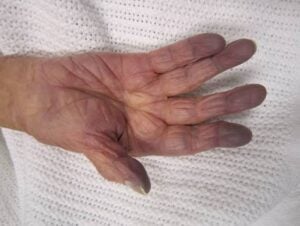
 Cyanosis is defined as a bluish discoloration of the skin and mucous membranes, which is caused by an increased concentration of oxygenated, hemoglobin, (typically exceeding 5 g/dL) in the capillary circulation.
Persistent hypoxemia is associated with hematologic abnormalities – secondary erythrocytosis, hyperviscosity, and iron dysregulation, endothelial dysfunction, and increased risk of thromboembolic and hemorrhagic complications that can cause kidney impairment, hepatic fibrosis, or cirrhosis, reduced exercise capacity, and neurocognitive effects such as anxiety or attention disorders.
Cardiac related cyanosis results from reduced pulmonary blood flow and right to left shunt as in ,Tetralogy of Fallot, parallel circulation with D Loop transposition of the great arteries, or intracardiac mixing of systemic, and pulmonary venous return with a single ventricle.
Cyanosis is a medical symptom rather than a disease itself, typically observed in areas with thin skin like the lips, nail beds, and earlobes.
Central Cyanosis occurs when there is an overall low oxygen level in the arterial blood.
It affects the core of the body, including the tongue, lips, and inside of the mouth.
Affects the entire body, including the lips, tongue, and mucous membranes. It usually signals a serious issue with the lungs, heart, or blood’s oxygen-carrying capacity (e.g., arterial oxygen saturation often below 85%).
The primary sign is the blue/gray/purple tint, most visible in areas with thin skin or rich blood supply (lips, nail beds, earlobes). In people with darker skin tones, it may appear as a grayish or ashen hue rather than blue.
Causes: Often points to underlying heart or lung problems.
Common triggers include Chronic Obstructive Pulmonary Disease (COPD), pneumonia, pulmonary embolism, asthma, or congenital heart defects.
Peripheral Cyanosis: this occurs when there is a good supply of oxygenated blood leaving the heart, but the circulation to the extremities slows down, causing the body tissues to extract more oxygen than usual.
It is isolated to the hands, fingers, feet, and toes.
Causes: Typically triggered by localized poor blood flow or restricted circulation; can be caused by exposure to extreme cold, Raynaud’s phenomenon, blood clots, or heart failure.
Immediate medical attention is necessary if the blue discoloration is accompanied by:Difficulty breathing or shortness of breathChest pain or dizzinessA rapid heartbeat or high fever, confusion or fainting
Cyanosis is a bluish or purplish discoloration of the skin, lips, tongue, gums, nail beds, or mucous membranes caused by insufficient oxygen in the blood (specifically, elevated levels of deoxygenated hemoglobin, typically around 5 g/dL or more in the capillaries).5
Peripheral cyanosis, is also called acrocyanosis when limited to extremities: Primarily affects the hands, feet, fingers, toes, and sometimes the area around the lips.
It results from reduced blood flow to the extremities by vasoconstriction rather than overall low oxygen levels.
The mucous membranes are typically spared.
A rarer form where only certain parts of the body are affected (e.g., blue lower body but pink upper body), often seen in specific congenital heart defects.
In newborns, mild acrocyanosis (blue hands/feet) is common and often harmless, especially when cold, as long as the central areas (lips, tongue) are pink.
Cyanosis stems from low oxygen in the blood or poor circulation.
Common categories include:
Lung problems: Pneumonia, COPD, asthma exacerbation, pulmonary embolism, or respiratory distress.
Heart issues: Congenital heart defects, heart failure, or conditions causing right-to-left shunting of blood.
Blood disorders: Methemoglobinemia, sulfhemoglobinemia, or severe anemia.
Circulatory issues: Cold exposure, Raynaud’s phenomenon, shock, vasoconstriction, or blood clots.
Other: High altitude, certain drugs/toxins, or central nervous system depression affecting breathing.
Cyanosis may be accompanied by symptoms of the underlying cause, such as shortness of breath, rapid breathing, chest pain, confusion, or fatigue.
Diagnosis
Physical exam (checking central vs. peripheral). Pulse oximetry (oxygen saturation). Arterial blood gas (ABG) test. Chest X-ray, echocardiogram, or other imaging as needed.2
Treatment
Treatment targets the underlying cause, not the discoloration itself: Supplemental oxygen for hypoxemia. Warming for cold-induced peripheral cyanosis. Medications or surgery for heart/lung conditions. Addressing specific issues like infections or toxins.
Mild peripheral cyanosis from cold often resolves with warming and doesn’t require medical intervention.
Immediate care is needed if cyanosis appears suddenly, affects the lips/tongue/central body, or occurs with difficulty breathing, chest pain, dizziness, or altered mental status.
It can signal a life-threatening emergency like severe pneumonia, heart failure, or pulmonary embolism.
Place on site with image