
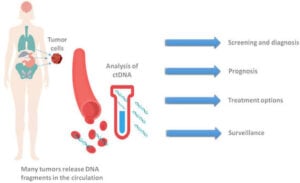
 Circulating Tumor DNA in Breast Cancer Management
ctDNA analysis has emerged as a transformative biomarker platform in breast cancer, with distinct roles in the early-stage and metastatic settings.
ctDNA is being used to detect molecular residual disease after curative-intent treatment — finding it before imaging shows recurrence.
In metastatic disease, ctDNA-based detection of actionable mutations (PIK3CA, ESR1, AKT1/PTEN) is guideline-endorsed and has FDA-approved companion diagnostics.
In early-stage disease, ctDNA-based minimal residual disease (MRD) detection has strong prognostic validity.
The detection of ctDNA after definitive treatment, term molecular residual disease (MRD) is strongly prognostic of recurrence, preceding clinical relapse by up to 15 months, providing a potential window for therapeutic intervention.
ctDNA quantitatively serves as a sensitive gauge for the presence of MRD in the bloodstream and can provide dynamic read out of response when tracked longitudinally.
Highly sensitive assays are required for the accurate detection of MRD, where ctDNA may be present at tumor fraction of less than 0.01% fraction of tumor derived cell free DNA in plasma.
ctDNA testing is an established tool for identifying druggable alterations in HR+/HER2− metastatic breast cancer.
CtDNA detection during molecular residual disease surveillance in patients with triple negative breast cancer is highly prognostic for recurrence.
The NCCN Guidelines specify biomarker–drug pairings detectable by tissue or plasma NGS/PCR:
PIK3CA activating mutations → alpelisib/fulvestrant, inavolisib/fulvestrant/palbociclib, capivasertib/fulvestrant
ESR1 mutations → elacestrant, imlunestrant, vepdegestrant
PIK3CA/AKT1/PTEN alterations → capivasertib/fulvestrant
PIK3CA mutations occur in approximately 40% of HR+/HER2− breast cancers.
The phase 3 SOLAR-1 trial (N=572) demonstrated that alpelisib plus fulvestrant significantly prolonged PFS versus placebo plus fulvestrant in PIK3CA-mutated cancers (median PFS 11.0 vs. 5.7 months) with no benefit in wild-type tumors.
ctDNA sensitivity for PIK3CA was limited in SOLAR-1: only 56% of patients with tissue-confirmed PIK3CA mutations had mutations detected in plasma using the therascreen PIK3CA RGQ PCR Kit.
This led to the FDA-approved reflex testing approach — plasma testing first, followed by tissue testing if negative.
Sensitivity improves substantially with higher ctDNA tumor fraction, reaching approximately 95% when tumor fraction exceeds 2%.
Overall concordance between tissue and ctDNA for PIK3CA variants is approximately 91% in paired analyses.
ESR1 mutations represent the most common mechanism of acquired resistance to aromatase inhibitors (AIs), present in fewer than 5% of patients at baseline but emerging in approximately 40% at progression on first-line AI plus CDK4/6 inhibitor therapy.
ctDNA is the preferred modality for ESR1 detection because these mutations are frequently subclonal and polyclonal, with ctDNA capturing mutations across multiple metastatic sites that a single tissue biopsy may miss.
Routine ESR1 testing at recurrence or progression on endocrine therapy is recommended, with blood-based ctDNA preferred.
Trials have demonstrated the clinical utility of ctDNA-guided therapy switching based on emerging ESR1 mutations:
These trials provide evidence that serial ctDNA monitoring can identify a window for preemptive therapy switching before radiologic progression, though overall survival data remain immature.
Tissue vs. Liquid Biopsy: Complementary Roles
In the plasmaMATCH trial (N=1,051), ctDNA digital PCR sensitivity for tissue-confirmed mutations was 93% overall and 98% with contemporaneous biopsies.
In a large concurrent testing study overall concordance was 59.4%, with 19.7% of variants detected uniquely by ctDNA (predominantly ESR1) and 20.9% uniquely by tissue (predominantly PIK3CA).
ESR1 variants are disproportionately detected by ctDNA while PIK3CA shows the highest concordance between modalities.
Quantitative ctDNA dynamics correlate with treatment response across MBC subtypes.
Methylation-based tumor fraction (mTF) is detectable in 94.7% of ER+/HER2− MBC patients at baseline, and clearance on CDK4/6 inhibitor plus endocrine therapy is associated with prolonged time to treatment discontinuation, with molecular progression preceding treatment discontinuation by a median of 5.8 months.
In the PADA-1 biomarker analysis, a ctDNA-based risk model integrating baseline and dynamic features improved survival discrimination beyond RECIST (C-index 70.0% vs. 60.3% for OS; However, no guideline currently recommends serial ctDNA monitoring as a substitute for imaging in routine practice.
ctDNA-based MRD detection has robust prognostic validity across all breast cancer subtypes.
A meta-analysis of 18 prospective studies found ctDNA positivity significantly associated with shorter DFS.
Postoperative ctDNA detection is among the strongest single prognostic markers. In the PREDICT-DNA study, (HER2+ and TNBC), detectable ctDNA after surgery identified patients at extremely high recurrence risk., while ctDNA-negative patients had 94% 5-year invasive disease-free survival.
Serial testing substantially improves accuracy: sensitivity increases from approximately 40% at a single landmark timepoint to approximately 79% with serial surveillance, without substantial loss of specificity.
ctDNA behavior varies meaningfully by subtype:
The longer lead time in HR+/HER2− disease creates a potentially wider therapeutic window for intervention, while the short lead time in TNBC poses a significant challenge for ctDNA-guided escalation strategies.
ctDNA clearance during neoadjuvant therapy refines prognosis beyond pathologic complete response (pCR).
In I-SPY2 (N=723), among patients with residual breast cancer-II/III, 3-year distant relapse-free survival was 98% for persistently ctDNA-negative patients versus 35% for those with no clearance.
Importantly, ctDNA does not reliably predict pCR — in PREDICT-DNA, the NPV of post-NAT ctDNA for pCR was only 60% — but it provides markedly superior prognostic stratification for long-term outcomes independent of pCR status.
The two completed randomized trials of ctDNA-guided therapy in early breast cancer have not demonstrated clinical utility.
More encouraging early results come from the DARE trial (phase 2, HR+/HER2−), where ctDNA clearance rates were 63% with fulvestrant plus palbociclib versus 22% with continuation of standard endocrine therapy, and only 29% of ctDNA-positive patients had metastatic disease at detection, reflecting the longer intervention window in HR+ disease).
Detection of ctDNA depends on assay sensitivity and tumor biology with more than 90% of triple negative and ERBB-2 positive tumors are ctDNA positive before neo adjuvant therapy, while the proportion decreases for luminal tumors, which is consistent with a different replication rate in tumor shedding of these types.
Within tumor types tumor fraction increases with the disease, burden and associated with nodal status and tumor stage.
Tumor-informed assays (e.g., Signatera, NeXT Personal, RaDaR) track dozens to thousands of patient-specific variants identified from tumor sequencing, achieving limits of detection of 1–3 parts per million.
They offer superior sensitivity but require adequate tissue (~20% patient ineligibility) and longer turnaround times.
Tumor-agnostic assays (e.g., Guardant Reveal) use methylation, fragmentomics, and aneuploidy features without requiring tissue, offering universal applicability but substantially lower sensitivity in early-stage disease.
A hybrid approach combining both components detected MRD in 31.1% of patients, with roughly equal proportions detected exclusively by each method, suggesting biological complementarity.
Three FDA-approved companion diagnostics are available for breast cancer ctDNA testing in the metastatic setting: the therascreen PIK3CA RGQ PCR Kit (tissue and plasma, for alpelisib), FoundationOne Liquid CDx (NGS-based, for PIK3CA/comprehensive profiling), and Guardant360 CDx (NGS-based, companion diagnostic for elacestrant via ESR1 detection).
ctDNA testing in metastatic breast cancer can identify actionable mutations to guide targeted therapy selection.
Key points of consensus and divergence:
Metastatic setting: ctDNA is preferred for ESR1 testing; tissue or ctDNA for PIK3CA, tissue preferred for PTEN copy loss and TMB.
Early-stage MRD: All three guidelines agree that ctDNA-based MRD testing is not recommended for routine clinical practice due to lack of demonstrated clinical utility: baseline cTDNA detection is relevant for treatment dynamics, which are significantly associated with outcomes.
Early clearance of ctDNA is associated with longer relapse free intervals and cleared ctDNA patients have the potential to be remain progression free.
ctDNA correlates with survival in neoadjuvant studies after surgery.
ctDNA testing may be used when tissue testing is not feasible, poses unacceptable risk, or when a drug’s regulatory indication allows or requires ctDNA testing.
Negative ctDNA results should prompt tissue-based confirmation.
The most accurate prediction of outcomes by MRD status is repeated testing.
MRD positivity after surgery suggests the need for treatment escalation.
In the surveillance setting after completion of systemic therapies serial ctDNA allows for detection of MRD months to years before clinical relapse, and almost all patients who develops MRD experience, distant recurrence with sufficient follow up.
De-escalation: Safe-De (NCT05058183) is evaluating omission of chemotherapy in stage I TNBC/HER2+ patients who are MRD-negative; SIGNAL-ER 101 (NCT07214532) is testing CDK4/6 inhibitor only for ctDNA-positive HR+/HER2− patients.
Escalation in TNBC: PERSEVERE (NCT04849364) is an umbrella trial with talazoparib, pembrolizumab, or inavolisib plus capecitabine for MRD-positive TNBC.
Escalation in HR+/HER2−: TRAK-ER (NCT04985266) and TREAT-ctDNA (NCT05512364) are large phase 3 trials evaluating CDK4/6 inhibitor-based or SERD-based escalation for ctDNA-positive patients.
Overarching: SURVIVE is a phase 3 trial comparing liquid biopsy-based follow-up versus standard surveillance, with overall survival as the primary endpoint.
In metastatic breast cancer, ctDNA testing is a validated, guideline-endorsed tool for detecting actionable mutations (PIK3CA, ESR1, AKT1/PTEN) to guide targeted therapy selection, with three FDA-approved companion diagnostics available.
The PADA-1 and SERENA-6 trials have demonstrated that serial ctDNA monitoring for emerging ESR1 mutations can identify a preemptive switching window that improves PFS, representing the strongest evidence for ctDNA-guided treatment adaptation in oncology.
In early-stage breast cancer, ctDNA-based MRD detection has exceptional prognostic validity (pooled HR ~7–14 for recurrence), with a median lead time of 10–20 months over clinical relapse that varies by subtype.
However, clinical utility remains unproven.
But clinical guidelines currently discourage routine ctDNA testing outside of clinical trials because no trial has yet shown that acting on a positive ctDNA result actually improves outcomes.
Intensifying therapy when ctDNA turns positive, to try to delay or prevent metastatic recurrence.
De-escalation:safely omitting adjuvant chemo in patients who stay ctDNA-negative after surgery.
Recent data continue to support ctDNA’s strong prognostic value, but prognostic isn’t the same as actionable— that’s the current gap.
Metastatic setting — this is where it’s most established ctDNA already has real clinical utility here:
Detecting ESR1 mutations that predict resistance to aromatase inhibitors, guiding a switch to drugs like elacestrant
ctDNA may serve as a supplemental tool in rare instances where tissue is unobtainable, with results interpreted alongside clinical and radiologic findings.
ctDNA is a validated, guideline-supported biomarker for genotyping and monitoring metastatic disease, but for early-stage disease it remains investigational for treatment decisions — strong prognostic signal, not yet proven to change outcomes when acted on.