
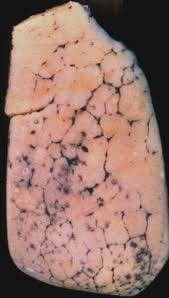
 Anthracosis is a lung condition caused by the inhalation and accumulation of carbon or coal dust particles in the lungs and airways.
It is often asymptomatic, it is the mildest form of pneumoconiosis (often called “black lung disease”).
While common in coal miners, it also frequently appears in urban dwellers and heavy smokers due to exposure to air pollution and biomass smoke.
Fine carbon particles are inhaled and ingested by immune cells the macrophages, in the lung, which deposit the black pigment into the lung tissue, lymph nodes, and bronchial walls.
Simple anthracosis is often benign and produces no symptoms.
However, if the dust accumulation is severe or progresses into more advanced stages, it can cause chronic coughing, sometimes with black mucus, shortness of breath, and chest tightness.
Complications: In severe cases, the dust can trigger inflammation and fibrosis in the airways, a condition known as bronchial anthracofibrosis or coal workers’ pneumoconiosis, which can block airways and lead to chronic breathing issues similar to COPD.
Diagnosis: It is often discovered incidentally during routine chest X-rays, CT scans, or a bronchoscopy, as doctors directly observe black patches in the airways.
At risk individuals
Coal Miners: Prolonged exposure to coal dust without adequate respiratory protection is the primary occupational cause.
Urban Dwellers: Minor anthracotic pigment is found in the lungs of most people living in highly polluted cities.
Biomass/Wood Smoke Exposure: Long-term exposure to indoor cooking or heating smoke, especially in unventilated areas, is a major contributor.
Smokers: The inhalation of tobacco smoke deposits tar and carbon, contribute to the condition.
The term is often used for black pigmentation seen in bronchial or lung tissue from inhaled carbon-containing particles. In some cases, it is part of a broader dust-related lung disease process that can progress to fibrosis, airway narrowing, or impaired lung function.
When disease is more advanced, imaging or bronchoscopy may show anthracotic pigmentation, lymph node changes, bronchial narrowing, atelectasis, or fibrosis.