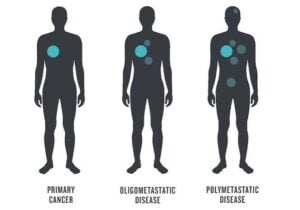
 Oligometastatic non-small cell lung cancer (NSCLC) represents a clinically and biologically distinct state of metastatic disease characterized by a limited number of metastatic lesions, typically up to five, in a restricted number of organs.
For oligometastatic non-small cell lung cancer definitive local tumor control accomplished by local radical treatment can prevent tumor growth and further metastasizing, and can alleviate morbidity caused by metastasis.
Two primary categories OMD: genuineOMD which includes denovo and repeat presentations, and induced OMD, which is associated with shorter overall survival.
Within genuine, OMD, further sub categorization is based on the timing of disease presentation: synchronous OMD defined as OMD present at initial diagnosis, and metachronus OMD defined as the emergence of new oligometastases more than six months after starting the initial treatment
Classified oligometastatic disease (OMD) into nine distinct states using a hierarchical decision tree based on five characterization factors: history of polymetastatic disease, history of prior OMD, timing relative to primary diagnosis, active systemic therapy status, and lesion progression status.
The primary distinction is between genuine (de novo) OMD, which includes synchronous OMD (present at initial diagnosis or within 6 months) and metachronous OMD (developing more than 6 months after initial treatment), and induced OMD, which arises after successful systemic therapy for previously polymetastatic disease.
Additional subtypes include oligoprogressive disease (progression at a limited number of sites during active systemic therapy), oligopersistent disease (stable or partially responsive limited disease during systemic therapy), and oligorecurrent disease (limited new metastases after prior control, off systemic therapy).
Epidemiologically, approximately 16–28% of patients with metastatic NSCLC present with oligometastatic disease at diagnosis, depending on the criteria applied and the rigor of imaging.
A prospective cohort of 623 patients found that 16.5% met criteria for OMD (≤5 disease sites), while another study using contemporary clinical trial criteria reported that 28% of patients with metastatic NSCLC would have been eligible for oligometastatic trials, with about 48% presenting with three or fewer metastases at diagnosis.
Patients with oligometastatic NSCLC have significantly better survival outcomes compared to those with widely metastatic disease.
In a prospective cohort with long-term follow-up (median 68.6 months), median overall survival (OS) was 30.8 months for oligometastatic patients versus 16.4 months for polymetastatic patients.
Multicenter data corroborate these findings, reporting median OS of 27.8–34.4 months and 5-year OS rates of 29–37.7% in patients who completed local ablative therapy (LAT) to all sites.
In contrast, patients with widely metastatic NSCLC (≥4 metastatic organs or liver involvement) have median OS as low as 7.7 months.
Accurate identification of oligometastatic NSCLC requires comprehensive imaging and, whenever feasible, pathological confirmation.
Whole-body 18F-FDG positron emission tomography–computed tomography (PET-CT) is the preferred staging modality, supplemented by contrast-enhanced CT of the chest and upper abdomen and brain magnetic resonance imaging (MRI) for all at-risk patients.
MRI of the brain is part of the staging workup, noting that CT is an acceptable alternative if MRI is unavailable.
Pathological confirmation of at least one metastatic lesion is advocated to confirm the diagnosis and enable molecular profiling, particularly to distinguish metastatic disease from multiple synchronous primary tumors.
Circulating tumor DNA (ctDNA) is the most advanced molecular biomarker in this setting.
A multi-institutional cohort study of 1,487 patients demonstrated that patients with undetectable ctDNA prior to radiotherapy had significantly improved progression-free survival (PFS) and OS, while higher ctDNA variant allele frequency (VAF) and mutational burden were inversely correlated with outcomes.
Patients with OMD were less likely to have detectable ctDNA (39.8% vs. 70.0%.
PD-L1 tumor proportion score (TPS) is another important biomarker.
Consolidation radiotherapy (cRT) significantly improved PFS and OS in patients with PD-L1 TPS 0–49% but not in those with PD-L1 TPS ≥50%, suggesting that PD-L1 TPS may guide patient selection for consolidative radiotherapy in the immunotherapy era.
PET/CT imaging, has demonstrated prognostic value complementary to ctDNA, with distinct PET/CT subtypes maintaining prognostic significance after adjusting for clinicopathologic risk factors.
MicroRNA profiles have also been proposed to differentiate true oligometastatic from polymetastatic disease, though external validation remains limited.
The current treatment paradigm for oligometastatic NSCLC involves initial systemic therapy tailored to the molecular and immunologic profile of the tumor, followed by local consolidative therapy (LCT) to all sites of disease in patients who achieve at least stable disease.
Guidelines recommends at least three months of optimal systemic therapy before considering definitive local therapy, with the exception of symptomatic or life-threatening metastases requiring upfront local intervention.
For patients without actionable driver mutations, the standard systemic backbone is platinum-doublet chemotherapy combined with immune checkpoint inhibitors (ICIs) such as pembrolizumab, nivolumab, or atezolizumab.
For patients with EGFR mutations, recommendation for first-line osimertinib, with consolidative stereotactic radiotherapy to oligoresidual disease supported by phase II data showing a median PFS of 29.9 months and a propensity-matched HR of 0.46 versus TKI alone.
For ALK-positive disease, continuation of alectinib with adjunct LAT for oligoprogression has demonstrated a median PFS of 8 months with minimal toxicity.
Local ablative therapy modalities include stereotactic body radiotherapy (SBRT/SABR), surgical resection, and other ablative techniques such as microwave ablation and cryoablation.
SBRT has become the preferred modality for most extracranial sites due to its non-invasiveness, precision, and favorable toxicity profile.
The evidence for local consolidatve treatment in oligometastatic NSCLC: randomized patients with ≤3 non-progressing metastatic lesions after first-line systemic therapy to LCT versus maintenance therapy, demonstrating a median PFS of 14.2 versus 4.4 months and a median OS of 41.2 versus 17.0 months in the LCT arm.
The Iyengar et al. trial randomized patients with ≤6 non-progressing lesions to maintenance therapy with or without SBRT, showing a median PFS of 9.7 versus 3.5 months.
A meta-analysis of available data confirmed that LCT was associated with a hazard ratio for PFS of 0.30 and for OS of 0.41 in patients with oligometastatic NSCLC, without a significant increase in grade ≥3 adverse events .
The SABR-COMET trial demonstrated a 22-month improvement in OS with the addition of SABR to all metastatic sites in patients with up to five metastases from various solid tumors.
The immunotherapy era: the BOOSTER randomized phase II trial compared ablation plus immunotherapy versus immunotherapy maintenance alone in patients with oligoresidual disease after anti-PD-1/L1 therapy, finding significantly longer median PFS (26.7 vs. 11.7 months) and a trend toward longer OS.
A phase II trial of adjuvant pembrolizumab following LAT to all sites of oligometastatic NSCLC (≤4 metastatic sites) reported a median PFS of 19.7 months and a 5-year OS rate of 60%, with median OS not reached at 65.8 months of follow-up.
A phase 1b trial combining dual checkpoint immunotherapy (tremelimumab and durvalumab) with SBRT to all metastatic sites reported a median PFS of 42 months, with median OS not yet reached.
Real-world data from a multicenter German cohort demonstrated that the addition of ICIs to chemotherapy doubled recurrence-free survival (2-year RFS 51.4% vs. 15.1%).
The most significant contemporary controversy centers on the benefit of local consolidative therapy in the immunotherapy era.
The NRG-LU002 phase 2/3 trial evaluated LCT in the context of ICI-based systemic therapy, randomized patients with ≤3 extracranial metastases who achieved at least stable disease after induction systemic therapy to maintenance therapy with or without LCT.
The trial found no significant improvement in PFS or OS with the addition of LCT, either in the overall cohort or in the ICI-treated subgroup.
The results challenge the previous paradigm established by pre-immunotherapy trials and raise fundamental questions about whether a distinct oligometastatic state exists in which LCT offers a survival advantage beyond what modern systemic therapy alone can achieve.
Retrospective and prospective studies continue to demonstrate substantial survival benefits in selected patients, particularly those who complete LAT to all sites and receive contemporary systemic regimens.
The CURB trial, evaluating SBRT in oligoprogressive NSCLC and breast cancer, found that SBRT allowed patients to remain on their existing systemic therapy for longer periods, with equivalent quality of life (QoL) scores between groups.
The integration of predictive biomarkers into clinical decision-making represents the most promising avenue for optimizing outcomes in oligometastatic NSCLC.
Pre-radiotherapy ctDNA detection, variant allele, and mutational burden have demonstrated independent prognostic value for PFS and OS, and may identify patients most likely to benefit from locally consolidative therapy versus those who should be prioritized for systemic treatment.
PD-L1 tumor proportion score (TPS) may further refine patient selection, with evidence suggesting that patients with PD-L1 TPS 0–49% derive the greatest benefit from the addition of cRT to immunotherapy, while those with PD-L1 TPS ≥50% may achieve sufficient disease control with immunotherapy alone.
Radiomics and ctDNA analysis are emerging tools that may further improve risk stratification, with AI-enabled assays achieving 0.002% mutant allelic fraction detection and 94% relapse detection sensitivity.
Several ongoing phase III trials, including SABR-COMET-3, SABR-COMET-10, and OMEGA, are expected to provide definitive evidence regarding the role of local consolidative therapy in the context of modern systemic therapy.
The LONESTAR, NORTHSTAR, and BRIGHTSTAR trials are evaluating the integration of surgery with systemic therapies, including targeted agents and immunotherapy, in selected patients with oligometastatic NSCLC.
Implementation of guideline-recommended multidisciplinary care faces real-world barriers, including variability in access to multidisciplinary teams, advanced local therapy modalities (SBRT, minimally invasive surgery), and high-quality imaging (PET-CT, brain MRI) across healthcare settings.
Clinical practice guideline all emphasize that multidisciplinary team involvement is mandatory for optimal patient selection and treatment planning.
For patients who achieve at least stable disease, LCT to all sites of disease (SBRT, surgery, or ablation) should be considered, with maintenance systemic therapy continued thereafter.
Patient selection should prioritize those with ECOG performance status 0–1, limited metastatic burden (ideally 1–2 lesions), and absence of rapidly progressive disease.