
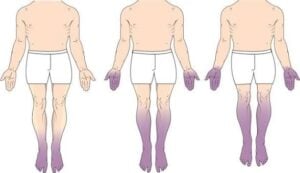
 It occurs when the body’s longest nerve fibers—those traveling all the way from the spinal cord to the toes—are damaged first because they are metabolically the most vulnerable.
Length-dependent peripheral neuropathy usually means a distal symmetric polyneuropathy: sensory symptoms begin in the toes, progress proximally in a “stocking” pattern, and may later involve the hands.
Symptoms:
Stocking-glove pattern: Symptoms typically begin symmetrically in the tips of the toes and feet, slowly work their way up the legs, and eventually appear in the fingertips and hands as they progress.
Sensory changes: Numbness, a “pins and needles” sensation, tingling, or unusual sensitivity to touch (allodynia).
Pain: A burning, sharp, or electric-shock-like pain that is often worse at night.
Weakness & Balance: Mild muscle weakness in the toes or ankles, or balance issues (gait ataxia) if larger sensory fibers or proprioception are involved.
Typical findings:
Burning, tingling, electric-shock pain, numbness, or impaired balance.
Reduced pinprick or temperature sensation from the toes upward.
Reduced vibration or proprioception, loss of ankle reflexes, and impaired protective sensation.
Weakness is usually late and distal; prominent early weakness is atypical.
Common Causes
Diabetes and prediabetes: Poor blood sugar control or impaired glucose tolerance is the leading cause.
Diabetes is the leading cause, but alcohol, vitamin B12 deficiency, renal or thyroid disease, neurotoxic medications, monoclonal gammopathy, amyloidosis, and hereditary neuropathies should also be considered.
Toxic-metabolic conditions: Vitamin B12 deficiency, uremia, or hypothyroidism.
Medications and toxins: Certain cancer chemotherapy drugs or heavy metal exposures.
Hereditary conditions: Such as Charcot-Marie-Tooth disease.
Idiopathic: In many cases, despite thorough blood and nerve testing, no underlying cause is ever found.
Diagnosis and Evaluation
History and examination: diabetes or impaired glucose tolerance, alcohol use, diet or gastrointestinal surgery, renal disease, thyroid disease, chemotherapy or other neurotoxic drugs, family history, autonomic symptoms, and foot injury risk.
Clinical assessment of pinprick and temperature, vibration, proprioception, 10-g monofilament sensation, and ankle reflexes; electrodiagnostic testing or neurology referral is mainly indicated when the presentation is atypical, the diagnosis is uncertain, or another etiology is suspected.
Nerve Conduction Studies (NCS) / Electromyography (EMG): Used to evaluate large sensory and motor nerve fibers and determine whether damage is axonal or demyelinating.
Electrodiagnostic testing: nerve-conduction studies and electromyography are useful when the diagnosis is unclear, to characterize axonal versus demyelinating disease, or when atypical features are present.
Pure small-fiber neuropathy may have normal nerve-conduction studies.
Skin Biopsy: Often used if small-fiber neuropathy is suspected, measuring intraepidermal nerve fiber density.
Blood Tests: Screen for diabetes, vitamin deficiencies, autoimmune diseases, or inflammatory markers.
Laboratory testing: fasting glucose and hemoglobin A1c; serum vitamin B12 with methylmalonic acid when appropriate; complete blood count; comprehensive metabolic panel; thyroid-stimulating hormone; and serum protein electrophoresis with immunofixation.
Treatment and Management
Strict blood sugar management for diabetes, correcting vitamin deficiencies, or discontinuing a culprit medications.
Symptom relief: Neuropathic pain is often managed with medications such as gabapentin, pregabalin, duloxetine, or tricyclic antidepressants.
Lifestyle and support: Regular exercise, maintaining a healthy weight, avoiding alcohol and tobacco, and using physical therapy or foot splints if foot drop or balance problems occur.
Features requiring prompt neurology assessment include rapid or acute/subacute progression, marked asymmetry, non-length-dependent or proximal involvement, motor-predominant weakness, sensory ataxia, severe autonomic dysfunction, systemic symptoms or weight loss, early respiratory or bulbar symptoms, or a strong family history.