
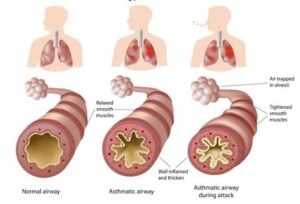
 Wheezing is a high-pitched whistling sound when breathing, usually from narrowed or blocked airways.
It is a high-pitched, musical sound produced when airflow through a narrowed or compressed segment of the airway becomes turbulent, causing oscillation of the airway walls
It arises from any process that narrows the intrathoracic small-to-medium airways — bronchoconstriction, mucosal edema/inflammation, luminal obstruction (mucus, foreign body), or external compression — and is typically loudest during expiration, though it can occur in both phases.
Asthma is most common cause, often with cough and chest tightness.
Allergies or a cold/respiratory infection
Bronchitis or pneumonia
COPD (in smokers or former smokers)
Acid reflux
Allergic reaction-if sudden and severe, this can be an emergency.
Anaphylaxis cause short-term wheezing.
Dfferential (adult): asthma/COPD, consider cardiac asthma (left heart failure/pulmonary edema), bronchiectasis, GERD, vocal cord dysfunction, pulmonary embolism, mechanical airway obstruction by tumor, foreign body,drug-induced (aspirin/NSAIDs, beta-blockers, ACE inhibitors), bronchiolitis, anaphylaxis, and less commonly carcinoid syndrome or factitious wheeze .
A monophonic/single-pitch wheeze suggests a fixed large-airway lesion — foreign body, tumor, tracheal stenosis, or external compression by nodes/an aneurysm — while polyphonic wheezing indicates diffuse small-airway obstruction typical of asthma or COPD
Evaluation:
History (onset speed, triggers, atopy, medication exposure) and physical exam (vital signs, SpO2, respiratory distress, localization of wheeze on auscultation) guide workup.
Spirometry with pre/post-bronchodilator testing, flow-volume loops, peak expiratory flow, CBC (eosinophilia), and CXR.
CXR is recommended for first-time wheezing or suspected structural disease.
Persistent or unexplained wheeze warrants CT chest and pulmonary evaluation.
Red flags —respiratory failure or impending compromise, anaphylaxis, or new wheeze with hemodynamic instability.
Management: Initial management prioritizes airway stabilization and treatment of rapidly reversible causes before pursuing etiology-specific diagnostics.
Azithromycin did not lead to a greater reduction in the severity of wheezing related symptoms, then placebo in preschool age children with moderate to severe acute wheezing.