
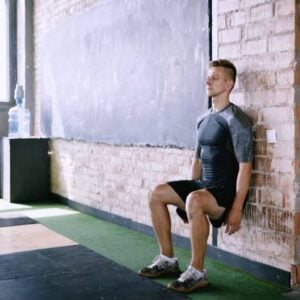
 Wall squats are a bodyweight exercise where you slide your back down a wall into a seated position and hold it.
They build lower-body strength and endurance using an isometric muscle hold without needing equipment.
How to Do Wall Squats Stand with your back and hips flat against a wall.
Walk your feet out hip-width apart, roughly 1 to 1.5 feet from the wall.
Lower down: Slowly slide your back down the wall until your knees bend.
Beginners often start at a shallower 45- to 60-degree angle, while more experienced lifters may lower to a 90-degree angle (thighs parallel to the floor).
Hold and align: Keep weight evenly distributed or slightly through your heels.
Keep your knees tracking over your feet without caving inward or pushing too far past your toes.
Rise up: Push through your feet to slide back up to the starting position.
Muscles Worked & Benefits
Primary muscles: Quadriceps and glutes drive the hold and push-up phase.
Supporting muscles: Hamstrings, calves, hip flexors, inner thighs, and core stabilizers help maintain balance and posture.
Key benefits: Because the wall supports part of your body weight and keeps movement controlled, wall squats are accessible and low-impact.
They support daily movements like standing from a chair or climbing stairs, improve joint stability, and have been studied for lowering resting blood pressure when practiced regularly.
Hold Duration & Progression
Beginners often hold a comfortable angle for 15 to 30 seconds (or perform short 10-second holds across reps) and rest between sets.
Building up: Gradually increase hold times—up to 60 seconds or more—or add sets as your muscles adapt.
Mild muscle shaking toward the end of a hold is common as muscles fatigue, though sharp knee or joint pain means you should stop and adjust depth.