
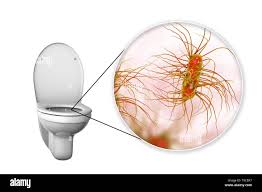
 The microbiome of a toilet is primarily composed of human-associated bacteria, specifically those from the skin and gut.
Toilet-adjacent surfaces (seat, rim, nearby floor, walls) carry a mix of microbes from skin, gut, urogenital tract, and the broader indoor environment.
The toilet microbiome usually refers to the microbial communities in and around toilets, and how they relate to the human gut and built-environment microbiomes.
While many associate toilets with fecal matter, skin-associated species often dominate the surfaces because they are more resilient to the dry, aerobic environment of the bathroom.
Dominant Microbial Groups Studies have identified four major phyla that make up about 92% of the bacterial sequences found on toilet and restroom surfaces:
Actinobacteria
Bacteroidetes
Firmicutes
Proteobacteria
The microbial community varies depending on the specific part of the toilet or the gender of its users:
Skin-Associated: Taxa like Propionibacteriaceae, Corynebacteriaceae, Staphylococcaceae and Streptococcaceae are abundant on hand-touch surfaces like the flush handle and the seat.
Gut-Associated: Families such as Bacteroidaceae, Prevotellaceae, and Ruminococcaceae are found in the bowl and on surfaces contaminated by “toilet plume”, aerosols from flushing.
Bacteroides vulgatus is one of the most common species shared between the gut and toilet surfaces.
Vagina-Associated: Lactobacillaceae are significantly more common in female restrooms, likely due to urine contamination.
Pathogens: Common opportunistic pathogens include E. coli, Salmonella, and Staphylococcus aureus.
Dominant phyla: Actinobacteria, Firmicutes, Proteobacteria, and Bacteroidetes, similar to human-associated communities but with a strong environmental signature.
Aerosolization: Flushing with the lid up can propel bacteria and viruses into the air at speeds up to 6.6 feet per second, reaching heights of 5 feet.
This plume disperses microbes onto surrounding surfaces like floors, ceilings, and even nearby toothbrushes.
Salmonella can colonize the underside of the toilet rim and persist for up to 50 days.
Bioburden Levels: In public or hospital settings, the heaviest microbial load or bioburden, is typically found on the floors and ceilings, while hand-touch sites like door handles are often cleaner due to more frequent sanitation.
Common genera: Skin-associated Staphylococcus and Corynebacterium are very frequent; other commensals like Finegoldia, Anaerococcus, and Gardnerella also appear on bathroom surfaces.
Roughly three‑quarters of the bathroom microbiome is traceable to human sources, with the skin microbiome alone contributing a large fraction of airborne and surface microbes.
In public and healthcare toilets, you see the same skin plus environment dominance, with occasional gut and waterborne organisms and, in clinical settings, hospital-associated flora.
Flushing generates aerosols that deposit microbes on nearby surfaces, especially floors and high surfaces like ceilings.
Floors typically have the highest colony counts; ceilings are surprisingly similar, supporting aerosol transport.
Immediately after cleaning, gut-associated microbes can briefly proliferate on surfaces, but many die off within hours because they are poorly adapted to cold, dry, oxygenated conditions.
A subset of organisms, including skin commensals and some environmental taxa, are more desiccation-tolerant and persist longer, shaping the steady-state bathroom microbiome.
Using lids may not completely prevent dispersion; one household study found that lid position did not markedly change the relative contribution of different human body sites to the bathroom microbiome.
In household bathrooms, about one-fifth of the detected surface microbiome appears intact or viable when using viability assays.
Strict anaerobes, including methanogenic archaea (Methanobrevibacter, Methanobacterium), can remain intact after oxygen exposure for up to roughly 48 hours on bathroom surfaces, suggesting potential (though unproven) capacity for re-colonization.
In healthcare toilets, typical environmental and skin flora dominate viable counts, and clinically relevant pathogens concentrate on floors and high-burden sites, informing cleaning-frequency and design recommendations.
A second, rapidly growing meaning of toilet microbiome is the use of stool and urine in the bowl as a continuous sampling window into the gut microbiome and host physiology.
Smart toilets with integrated sensors and sample capture can perform automated analysis of urine and stool to detect markers of metabolic disease, infections, or even cancer risk.
Research labs use stool collected via toilet-integrated systems and 16S rRNA or metagenomic workflows to track gut microbial composition longitudinally.
Infection risk: In normal community settings, most microbes detected on toilet surfaces are either non-viable or low-risk environmental/skin flora; risk is higher in healthcare environments, particularly on floors and heavily contaminated zones, reinforcing targeted cleaning and hand hygiene.
Bathrooms exemplify how human-associated and environmental microbiomes merge in the built environment, with skin microbes dominating long-term persistence.