
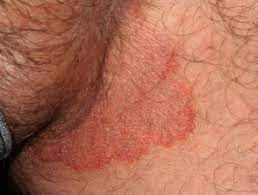
 A dermatophytosis that is commonly caused by Trichophyton rubrum or T. mentagrophytes.
Commonly referred to as Jock Itch.
Jock itch is a common, contagious fungal infection that causes an itchy, red rash in the groin, inner thighs, and buttocks.
It is typically caused by dermatophyte fungi that require keratin for growth.
It most commonly affects adolescent and young adult males.
The warm, moist environment of the groin area creates favorable conditions for fungal growth, particularly in settings of increased sweating, tight clothing, and poor hygiene.
The infection presents as red, scaly, pruritic patches on the upper thigh opposite the scrotum, with the scrotum typically spared—a key feature that helps differentiate it from candidal infections.
It thrives in warm, moist environments and is often caused by the same fungus as athlete’s foot.
Risk factors are associated with a moist environment as seen in warm weather, wet and restrictive clothing, and obesity causing constant approximarption of skinfolds.
Men are affected more than women due to the proximity of the scrotum and thigh.
The rash: presents with several key characteristics:
Red, Raised Edges.
The affected areas show well-demarcated borders with erythema and scaling.
It often starts in the groin crease and spreads outward in a ring-like shape.
It thrives in warm, moist environments and is often caused by the same fungus as athlete’s foot.
The warm, moist environment of the groin area creates favorable conditions for fungal growth, particularly in settings of increased sweating, tight clothing, and poor hygiene.
Color Variation: It appears red on lighter skin and may look purple, brown, or gray on darker skin.
Sensation: Intense itching, burning, or stinging in the affected area.
Texture: Skin may be scaly, flaky, peeling, or even develop small blisters along the border.
Differential diagnosis of tinea cruris includes:
Contact dermatitis
Psoriasis
Candidiasis
If appearance is not diagnostic, a potassium hydroxide wet mount is helpful to establish the presence of fungal elements.
Topical antifungal choices include terbinafine, miconazole, clotrimazole, ketoconazole, econazole, naftifine, and ciclopirox applied bid for 10 to 14 days.
Itraconazole 200 mg po once/day or terbinafine 250 mg po once/day for 3 to 6 wk may be needed in patients who have refractory, inflammatory, or widespread infections.
Treatment:
Most cases can be managed at home using over-the-counter products:
Most cases respond well to topical antifungal creams such as butenafine, ketoconazole, or terbinafine, typically applied once daily for one week.
The cream is spread about one inch beyond the visible border of the rash to ensure all fungal cells are covered.
Duration: Continue treatment for at least one week after the rash disappears to prevent it from returning.
Care and Prevention: Keeping the skin dry.
Wear loose-fitting cotton boxers rather than tight briefs to allow the skin to breathe.
Use one towel for the feet/groin and a separate clean towel for the rest of your body.
Dermatophytes spread through direct contact with infected people, animals, or contaminated surfaces (fomites).
Oral antifungal agents may be needed for extensive disease, lack of response to topical treatment, or immunocompromised patients.
Diagnosis is usually made clinically based on history and visual inspection, though potassium hydroxide (KOH) preparation can confirm the diagnosis when needed
It thrives in warm, moist environments and is often caused by the same fungus as athlete’s foot.
The warm, moist environment of the groin area creates favorable conditions for fungal growth, particularly in settings of increased sweating, tight clothing, and poor hygiene.
The infection presents as red, scaly, pruritic patches on the upper thigh opposite the scrotum, with the scrotum typically spared—a key feature that helps differentiate it from candidal infections.
The rash: presents with several key characteristics:
Red, Raised Edges.
The affected areas show well-demarcated borders with erythema and scaling.
It often starts in the groin crease and spreads outward in a ring-like shape.
Color Variation: It appears red on lighter skin and may look purple, brown, or gray on darker skin.
Sensation: Intense itching, burning, or stinging in the affected area.
Texture: Skin may be scaly, flaky, peeling, or even develop small blisters along the border.
Treatment:
Most cases can be managed at home using over-the-counter products:
Most cases respond well to topical antifungal creams such as butenafine, ketoconazole, or terbinafine, typically applied once daily for one week.
The cream is spread about one inch beyond the visible border of the rash to ensure all fungal cells are covered.
Duration: Continue treatment for at least one week after the rash disappears to prevent it from returning.
Care and Prevention: Keeping the skin dry.
Wear loose-fitting cotton boxers rather than tight briefs to allow the skin to breathe.
Use one towel for the feet/groin and a separate clean towel for the rest of your body.
Dermatophytes spread through direct contact with infected people, animals, or contaminated surfaces (fomites).
Oral antifungal agents may be needed for extensive disease, lack of response to topical treatment, or immunocompromised patients.
Diagnosis is usually made clinically based on history and visual inspection, though potassium hydroxide (KOH) preparation can confirm the diagnosis when needed.