
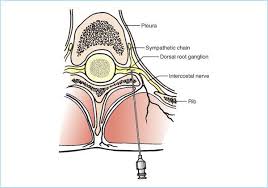
 Paravertebral block (PVB) is a regional anesthesia technique in which local anesthetic is injected into the paravertebral space adjacent to the vertebral bodies.
Paravertebral block (PVB) produces unilateral segmental analgesia by blocking the dorsal and ventral rami of the thoracic spinal nerves.
The paravertebral space lies lateral to the vertebral bodies, bordering the ribs and transverse processes.
The paravertebral space contains the thoracic spinal nerves as they emerge from the intervertebral foramen, their dorsal and ventral rami, and nearby sympathetic fibers:The pleura lies laterally.
Indications for Paravertebral block:
Postoperative analgesia for thoracic and upper abdominal surgery-thoracotomy, breast surgery, mastectomy, herniorrhaphy, appendectomy, video-assisted thorascopic surgery, surgical anesthesia for breast surgery, herniorrhaphy, acute postherpetic neuralgia, chronic pain management and treatment for fractured ribs.
Analgesia for rib fractures or chest wall trauma
Some as part of multimodal analgesia for other procedures involving the chest or upper abdomen
Indications include postoperative analgesia for thoracic surgery, breast surgery, cholecystectomy, renal and ureteric surgery, herniorrhaphy, appendectomy, video-assisted thorascopic surgery, surgical anesthesia for breast surgery, herniorrhaphy, acute postherpetic neuralgia, chronic pain management and treatment for fractured ribs.
Advantages
Generally unilateral with less hypotension and urinary retention
Good analgesia with relatively straightforward administration Fewer motor block and central neuraxis effects
Uses landmark-based or ultrasound-guided approaches,and ultrasound guidance increases safety by avoiding the pleura and identifying the paravertebral space.
Can be performed as a single-shot block or with catheters for continuous analgesia
Injection near the transverse process spread into the paravertebral space and blocks the corresponding dermatomes
Local anesthetics and dosing Common agents: ropivacaine or bupivacaine
Single-shot: doses are chosen to cover several thoracic levels-15–25 mL of 0.5% ropivacaine or equivalent per side.
Continuous catheter: low-concentration infusion (e.g., ropivacaine 0.2–0.4% at a CFR of a few mL per hour, with patient-controlled bolus options.
Complications:
Pneumothorax or pleural puncture due to proximity to the pleura Intrathecal or intravascular injection.
Hypotension or unintended bilateral block with high volumes
Local anesthetic systemic toxicity.
Infection or hematoma at the injection site
Block failure or incomplete sensory coverage
Contraindications and cautions:
Patient refusal, infection at the injection site, or known allergy to local anesthetics
Coagulopathy or anticoagulation are relative contraindication.
Severe pleural disease or other conditions where a paravertebral approach is unsafe
Ultrasound guidance improves accuracy and safety by visualizing the transverse process, pleura, and paravertebral space.
Failure rate from 6.8-10%.
Complication rate 2.6-5% and include vascular puncture, hypotension, pleural puncture and pneumothorax.
Paravertebral block (PVB) is a regional anesthesia technique in which local anesthetic is injected into the paravertebral space adjacent to the vertebral bodies.