
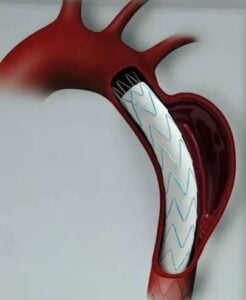
 Thoracic Endovascular Aortic Repair (TEVAR) is a minimally invasive surgical procedure used to treat damage in the thoracic aorta.
It serves as a modern alternative to traditional open-heart surgery, offering faster recovery times and lower immediate risks.
The procedure is primarily performed to reinforce the aortic wall using a stent graft—a metal mesh tube covered in fabric—to prevent life-threatening complications.
It is commonly used for thoracic aortic aneurysms, aortic dissections, particularly Type B dissections, traumatic Injuries: Tears or transections caused by high-impact accidents, and penetrating aortic ulcers.
TEVAR is performed in an operating room or catheterization lab and typically takes about two hours.
A small incision is made in the groin to access the femoral artery.
Guidance: Using X-ray imaging (fluoroscopy), a catheter carrying the collapsed stent graft is threaded up to the damaged area.
The stent is expanded like a spring to fit tightly against the aortic walls, creating a new path for blood flow and shielding the weakened area from pressure.
An angiogram is used to confirm the stent is properly positioned before closing the incision.
Most patients stay for 1 to 4 days for monitoring.
Surveillance: Because stent grafts can shift or leak over time, patients require lifelong monitoring with regular CT scans or ultrasounds (often annually).
TEVAR IS safer than open surgery, risks include: Endoleaks: Blood leaking around the graft into the aneurysm sac.
Stroke or Spinal Ischemia: Rare risks of paralysis or neurological issues due to blood flow changes.
Device Migration: The stent graft moving out of its original position.