
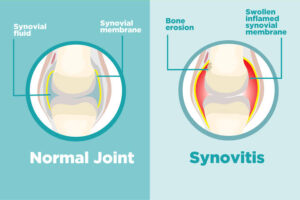
 Synovial membrane is a thin tissue that lines the diarthrodial joints.
Synovium means relating to the synovium or to synovial fluid—the specialized lining and lubricant system of freely movable joints.
Synovium refers to the tissue lining synovial joints, bursae, and tendon sheaths.
The synovium, also known as the synovial membrane, is a thin layer of soft tissue that lines the inner surface of capsules in moveable joints, tendon sheaths, and bursae.
Consists of a lining layer only a few cells thick with fibroblast like synoviocytes and macrophages which produce synovial fluid and extracellular matrix, and a sublining layer of loose connective tissue.
A synovial joint is the common, highly mobile type of joint, such as the knee, hip, shoulder, elbow, wrist, and ankle. Its defining feature is a fluid-filled joint cavity between the articulating bones.
Inflammation of the synovium is synovitis.
It can produce pain, warmth, swelling/effusion, stiffness, and reduced range of motion.
It is central to inflammatory arthritis such as rheumatoid arthritis, but can also occur with crystal arthritis, infection, trauma, osteoarthritis flares, and some proliferative synovial disorders.
With rheumatoid arthritis the lining layer has an increased in the number of cells and the sublining is infiltrated with inflammatory cells, including lymphocytes, mast cells and macrophages.
Synovitis is the hallmark of rheumatoid arthritis with an influx of inflammatory cells leading to multiple villous projections within the joint cavity.
Synovitis histologic features include synovial hyperplasia, heterogeneous inflammatory infiltrates that can include lymphoid aggregates and germinal center like structures with T and B cells, plasma cells, plasmablasts, macrophages, dendritic cells, occasional mast cells, and natural killer cells.
Molecular and histologic profiling of the synovium might provide insights into the response of B cell therapies or other chemokine receptor inhibitors.
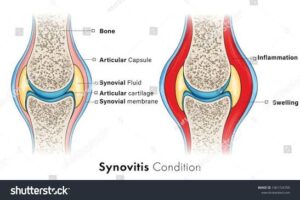
Synovium’s main components are:
Articular cartilage that covers the bone ends and minimizes friction/load concentration.
Fibrous joint capsule: the tough outer envelope that stabilizes the joint.
Synovial membrane (synovium): the vascular inner lining of the capsule; it produces and regulates synovial fluid.
Synovial fluid: a viscous, hyaluronan-rich fluid that lubricates the joint, contributes to cartilage nutrition, and helps maintain a low-friction surface.
Histologically the synovium has: Intima: a thin surface layer containing macrophage-like and fibroblast-like synoviocytes
Subintima: vascular connective tissue containing fibroblasts, extracellular matrix, vessels, lymphatics, and variable immune cells.
The synovium does not cover the articular cartilage; rather, it lines the non-cartilage internal surfaces of the joint capsule.
Inflammation of the synovium is synovitis.
It can produce pain, warmth, swelling/effusion, stiffness, and reduced range of motion.
It is central to inflammatory arthritis such as rheumatoid arthritis, but can also occur with crystal arthritis, infection, trauma, osteoarthritis flares, and some proliferative synovial disorders.
Synovial-fluid analysis is often used to distinguish noninflammatory, inflammatory, crystalline, and septic processes in an acutely swollen joint.
Synovium functions:
Makes fluid: It secretes a slippery liquid called synovial fluid.
Reduces friction: The fluid helps bones glide smoothly past each other during movement.
Nourishes joints: It delivers important nutrients and oxygen to the joint cartilage.
Cleans debris: Special cells inside the membrane remove wear-and-tear particles from the joint space.
Structure
Intima: The inner layer facing the joint cavity, made of macrophage-like cells and fibroblast-like cells.
Subintima: The outer supporting layer that contains blood vessels, fat, and connective tissue.
Inflammation-Synovitis
When the synovium becomes irritated or infected, it swells and hurts. This condition is called synovitis.
Common causes: Injury, overuse, gout, infections, or autoimmune diseases like rheumatoid arthritis.
Common symptoms: Joint pain, swelling, warmth, stiffness, and trouble moving the joint.
Treatments: Rest, physical therapy, and anti-inflammatory medications.