
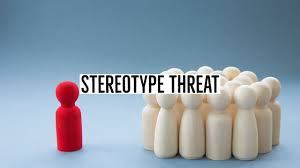
 Stereotype threat is a situational predicament in which people are or feel themselves to be at risk of conforming to stereotypes about their social group.
It is thought to contribute to long-standing racial and gender gaps in academic performance.
Factors that increase stereotype threat can include the difficulty of the task, the belief that the task measures their abilities, and the relevance of the stereotype to the task.
People show higher degrees of stereotype threat on tasks they wish to perform well on and when they identify strongly with the stereotyped group.
Such effects are increased when they expect discrimination due to their identification with a negatively stereotyped group.
Repeated experiences of stereotype threat leads to a vicious circle of diminished confidence, poor performance, and loss of interest in the relevant area of achievement.
Stereotype threat may show a reduction in the performance of individuals who belong to negatively stereotyped groups.
If negative stereotypes are present regarding a specific group, group members are likely to become anxious about their performance, which may hinder their ability to perform to their full potential.
The mechanism suggested through which anxiety induced by the activation of the stereotype decreases performance is by depleting working memory system).
The opposite of stereotype threat is stereotype boost, which is when people perform better than they otherwise would have, because of exposure to positive stereotypes about their social group.
A variant of stereotype boost is stereotype lift, which is people achieving better performance because of exposure to negative stereotypes about other social groups.
Meta-analyses and systematic reviews have shown significant evidence for the effects of stereotype threat, though the phenomenon defies over-simplistic characterization.
Stereotype threat is a contributing factor to long-standing racial and gender achievement gaps, such as under-performance of black students relative to white ones in various academic subjects, and under-representation of women at higher echelons in the field of mathematics.
The strength of the stereotype threat that occurs depends on how the task is framed.
If a task is framed to be neutral, stereotype threat is not likely to occur; however, if tasks are framed in terms of active stereotypes, participants are likely to perform worse on the task.
Stereotype threat can depress women’s entrepreneurial intentions while boosting men’s intentions.
When entrepreneurship is presented as a gender-neutral profession, men and women express a similar level of interest in becoming entrepreneurs.
Individuals who highly identify with a particular group appear to be more vulnerable to experiencing stereotype threat than individuals who do not identify strongly with the stereotyped group.
The mere presence of other people can evoke stereotype threat.
Women who took a mathematics exam along with two other women got 70% of the answers right, whereas women who took the same exam in the presence of two men got an average score of 55%.
Stereotype threat has been shown to disrupt working memory and executive function, increase arousal, increase self-consciousness about one’s performance, and cause individuals to try to suppress negative thoughts as well as negative emotions such as anxiety.
When a large portion of resources are spent focusing on anxiety and performance pressure, the individual is likely to perform worse on the task at hand.
Stereotype threat may also activate a neuroendocrine stress response, as measured by increased levels of cortisol while under threat.
The physiological reactions that are induced by stereotype threat can often be subconscious.
The physiological reactions that are induced by stereotype threat can distract and interrupt cognitive focus from the task.
Electroencephalogram (EEG) signals that measure electrical activity along the scalp, and found that individuals experiencing stereotype threat were more vigilant for performance-related stimuli.
Stereotype threat not only affects performance, but can also affect the ability to learn new information.
Stereotype threat concerns how stereotype cues can harm performance.
Stereotype activation can also lead to performance enhancement through stereotype lift or stereotype boost.
Stereotype lift increases performance when people are exposed to negative stereotypes about another group.
This enhanced performance has been attributed to increases in self-efficacy and decreases in self-doubt as a result of negative outgroup stereotypes.
Stereotype boost occurs when a positive aspect of an individual’s social identity is made salient in an identity-relevant domain.
Asian American women performed better on a math test when their Asian identity was primed compared to a control condiidentity was primed.
These participants did worse on the math test when instead their gender identity—which is associated with stereotypes of inferior quantitative skills—was made salient, which is consistent with stereotype threat.
Decreased performance is the most recognized consequence of stereotype threat.
Stereotype threat can cause individuals to blame themselves for perceived failures, self-handicap, discounting the value and validity of performance tasks, distancing themselves from negatively stereotyped groups, and disengage from situations that are perceived as threatening.
Studies examining stereotype threat in Black Americans have found that when subjects are aware of the stereotype of Black criminality, anxiety about encountering police increases.
Stereotype threat in Black Americans can lead to self-regulatory efforts, more anxiety, and other behaviors that are commonly perceived as suspicious to police officers.
If police officers tend to perceive Black people as threatening, their reactions to these anxiety-induced behaviors are commonly more harsh than reactions to White people with the same behavior, and influences whether or not they decide to shoot the person.
In the long run, the chronic experience of stereotype threat may lead individuals to disidentify with the stereotyped group: disidentification is thought to be a psychological coping strategy to maintain self-esteem in the face of failure.
Repeated exposure to anxiety and nervousness can lead individuals to choose to distance themselves from the stereotyped group.
Research suggests that, when women cope with negative stereotypes about their math ability, they perform worse on math tests, and that, well after completing the math test, women may continue to show deficits even in unrelated domains: overeating, be more aggressivity, make more risky decisions, and show less endurance during physical exercise.
The perceived discrimination associated with stereotype threat can also have negative long-term consequences on individuals’ mental health.
Individuals who experience more perceived discrimination are more likely to exhibit depressive symptoms, and has also been found to predict depressive symptoms in children and adolescents.
Other negative mental health outcomes associated with perceived discrimination include a reduced general well-being, post-traumatic stress disorder, anxiety, and rebellious behavior.
If people believe that they can improve their performance based on effort, they are more likely to believe that they can overcome negative stereotypes, and thus perform well.
Promoting cross-group relations between people of varying backgrounds has also been shown to be effective at promoting a sense of belonging among minority group members.
Students have a lower sense of belonging at institutions where they are the minority, but developing friendships with members of other racial groups increased their sense of belonging.
Allowing individuals to feel as though they are welcomed into a desirable group makes them more likely to ignore stereotypes.
The upshot is that if minority college students are welcomed into the world of academia, they are less likely to be influenced by the negative stereotypes of poor minority performance on academic tasks.
Informing college women about stereotype threat and its effects on performance was sufficient to eliminate the predicted gender gap on a difficult test.
Large well-controlled studies have tended to find smaller or non-significant effects, that evidence for stereotype threat in children may reflect publication bias.