
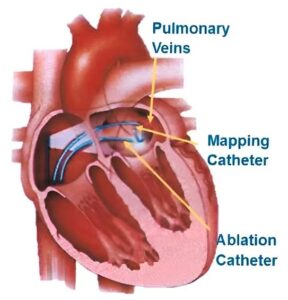
 See Ablation for atrial fibrillation
Pulmonary Vein Isolation (PVI) is a minimally invasive catheter ablation procedure used to treat Atrial Fibrillation (AFib).
It works by using heat (radiofrequency) or extreme cold (cryoablation) to create tiny scars around the pulmonary veins, blocking the erratic electrical signals that trigger irregular heartbeat.
In most people with AFib, the chaotic electrical triggers that cause the heart to beat irregularly originate inside the pulmonary veins-the four veins that bring oxygen-rich blood from the lungs back to the heart.
PVI electrically disconnects these veins from the left atrium so the rogue signals cannot reach the rest of the heart, allowing the heart to maintain a normal rhythm.
The Procedure is usually recommend PVI after medications or other treatments have failed to control AFib symptoms (like a racing heartbeat, shortness of breath, or fatigue).
Many electrophysiologists now use Pulsed Field Ablation (PFA), a newer, non-thermal method that uses electric fields to target heart tissue with high precision while minimizing damage to surrounding structures.
PVI is most effective in patients with paroxysmal AFib with success rates ranging from 60% to 80% in reducing the burden of the arrhythmia.
Patients often notice a significant improvement in their quality of life.
The procedure typically takes a few hours under anesthesia.
Full recovery and the healing of the scars inside the heart take about 1 to 3 months.
Potential Risks
Bleeding or bruising at the catheter insertion site (groin).
Blood clots or risk of stroke.
Narrowing of the pulmonary veins (pulmonary vein stenosis).
Damage to the nerves controlling the diaphragm.
Damage to the esophagus.