
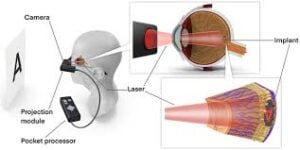
 The PRIMA (Photovoltaic Retina Implant Microarray) system is a subretinal neurostimulation device designed to restore central vision in patients with geographic atrophy due to age-related macular degeneration by replacing the function of lost photoreceptors.
The system has of three integrated components: a 2mm × 2mm subretinal photovoltaic implant containing 378 pixels (each 100 μm wide), specialized glasses with a frame-mounted camera and near-infrared projector, and a pocket processor.
The camera captures visual images and transmits them to the processor, which then projects the processed information onto the implant using near-infrared light (wavelength 880 nm) at 30 Hz frame rate.
The implant operates wirelessly through photovoltaic conversion.
Each pixel contains photodiodes that convert the projected near-infrared light into electrical current, which directly stimulates the surviving bipolar cells in the inner retina.
The process preserves inner retinal signal processing by stimulating bipolar cells rather than ganglion cells, unlike epiretinal implants.
Geographic atrophy causes loss of cells that respond to light a prosthetic system called PRIMA (photovoltaic retina implant microwave) can restore light perception to the central retina.
The PRIMA system includes a photovoltaic device, surgically implanted beneath the central retina, that receives in the year infrared red light projected from a camera on a pair of glasses.
The photovoltaic pixels in the device convert infrared light from the camera into electrical impulses that stimulate the retinal, bipolar cells, which connect with retinal ganglion cells and send visual information through the optic nerves to the brain for visual perception.
The device compensates for the missing macular vision cells by sending information through the inner retinal and optic nerve pathways to the brain.
The implant is only 30 μm thick, which is approximately half the height of a photoreceptor.
The implant integrates into the subretinal space without mechanical fixation hardware.
Clinical efficacy has been demonstrated in the recent PRIMAvera trial, where 81% of 32 participants with geographic atrophy achieved clinically meaningful improvement in visual acuity at 12 months.
Participants using the PRIMA system with paired glasses, vision improved from baseline levels by at least 10 letters (two lines) more on a standard chart than they could have at the start of the study.
Importantly, the transparent glasses allow simultaneous natural peripheral vision and prosthetic central vision, and residual natural acuity is preserved after implantation.
The wireless photovoltaic design represents a significant advancement over previous wired retinal prostheses, simplifying surgical implantation and reducing complications associated with permanent openings in the eye globe.
A total of 26 serious adverse events occurred among 19 of the 38 participants who received the implant and were followed for 12 months: the most common events were elevated intraocular pressure and peripheral retinal breaks.
The durability of this device and its effect on eye health over years is unknown.