
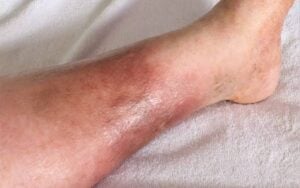
 Post-Thrombotic Syndrome (PTS) / Post-Phlebitic Syndrome
PTS is a form of chronic venous insufficiency that develops after an episode of acute deep vein thrombosis (DVT).
Despite adequate anticoagulation, it affects 20–50% of patients with DVT.
It develops secondary to ambulatory venous hypertension, caused by residual venous obstruction, valvular damage, or both.
It occurs when blood clots damage vein valves, causing blood to pool.
This increases vein pressure, resulting in persistent leg swelling, aching, and skin discoloration.
The principal risk factors are anatomically extensive DVT, recurrent ipsilateral DVT, obesity, and older age.
Typical symptoms are leg heaviness, pain, edema, and pruritus, which tend to worsen by end of day. Trophic changes range from hyperpigmentation to venous ulceration in the most severe form. PTS is not lethal but negatively impacts quality of life to a degree comparable to heart failure or diabetes mellitus.
Diagnosis should be deferred until 3–6 months after DVT, once the initial pain and swelling has resolved.
Management focuses on symptom relief through compression therapy, exercise, and pain control, while severe cases may require endovascular or surgical interventions.
Current options include targeted lifestyle modification, pharmacologic treatment, compression therapy, proper anticoagulation, and interventions such as thrombolysis, thrombectomy, and stenting.
For endovascular candidates: perioperative management should include therapeutic anticoagulation, early mobilization, compression therapy, and systematic follow-up with duplex ultrasound.
There is no effective treatment for established PTS, so management lies primarily in its prevention after DVT.
Optimal anticoagulation is key, and low-molecular-weight heparins have anti-inflammatory properties with a particularly attractive profile.
Symptoms typically emerge within 1 to 2 years following a DVT, but can take longer to appear.
Primary Cause: Even after successful DVT treatment, permanent damage to the vein’s valves allows blood to flow backward or pool, leading to chronic venous insufficiency.
Symptoms typically worsen with prolonged standing or activity and improve with rest or elevating the leg.
Signs include:
Chronic swelling (edema) in the affected limb
Pain, aching, cramping, or a feeling of heaviness
Skin discoloration (e.g., rusty brown spots or bluish tint)
Thickened, hardened, or itchy skin
Venous skin ulcers-open, painful sores near the ankle) in severe cases.
The management of postthrombotic syndrome (PTS) centers on compression therapy, lifestyle modifications (exercise, leg elevation, weight management), and wound care for venous ulcers, with endovascular stenting now supported by randomized trial evidence for patients with moderate-to-severe disease and iliac-vein obstruction.
PTS is diagnosed clinically based on persistent symptoms or signs of chronic venous insufficiency ≥3–6 months after DVT, in the absence of recurrent thrombosis.
The Villalta scale is the endorsed diagnostic tool, incorporating 5 symptoms (pain, cramps, heaviness, paresthesia, pruritus) and 6 signs (pretibial edema, skin induration, hyperpigmentation, redness, venous ectasia, pain on calf compression), each scored 0–3. Scores of 5–9 indicate mild PTS, 10–14 moderate, and ≥15 or presence of ulcer indicates severe PTS.
Compression therapy: Elastic compression stockings (ECS), typically knee-high at 20–30 mm Hg, remain the cornerstone of symptomatic management.
Compression level, stocking length, and adherence should be regularly reassessed.
For moderate-to-severe PTS with significant edema, intermittent pneumatic compression devices may be reasonable.
Lifestyle measures: Leg elevation, regular exercise, weight loss, smoking cessation, and avoidance of limb trauma are recommended.
Wound care: For patients with venous ulcers, multilayer compression and oral pentoxifylline are recommended, along with referral to a wound care clinic.
Evidence for pharmacological treatment of established PTS remains limited. Venoactive drugs (rutosides, hidrosmin, defibrotide, micronized purified flavonoid fraction, sulodexide) may provide short-term symptom relief, but long-term effectiveness and safety are uncertain.
Sulodexide has shown some benefit in promoting venous ulcer healing in meta-analysis.
Venoactive drugs may provide short-term relief but are not curative.[2]
Endovascular Therapy
The C-TRACT trial randomized 225 patients with moderate-to-severe PTS and imaging-confirmed iliac-vein obstruction to endovascular therapy (iliac-vein stent placement plus enhanced antithrombotic therapy) plus standard care versus standard care alone:
PTS severity at 6 months was significantly lower with endovascular therapy (mean VCSS 8.1 vs. 10.0.
Venous disease–specific quality of life improved by 14.5 points and SF-36 physical component summary improved by 6.1 points.
Bleeding was more common in the endovascular group (11.6% vs. 3.6%.
Post-stenting antithrombotic therapy in the trial included therapeutic anticoagulation plus aspirin 81 mg daily for at least 6 months.
For severely symptomatic patients with iliac vein or vena cava occlusion refractory to other therapies, considers femoro-femoral or femoro-caval bypass, segmental vein valve transfer, or venous transposition as options.
Optimal anticoagulation after DVT is key for PTS prevention.
Extended anticoagulation beyond 3 months is generally not recommended solely for PTS prevention.
Small studies suggest rivaroxaban may offer better PTS prevention than vitamin K antagonists, and LMWH may have advantages due to anti-inflammatory properties, but no definitive recommendations exist.
Emerging data suggest statins and colchicine may modulate vein wall inflammation and fibrosis, though large trials are lacking.