
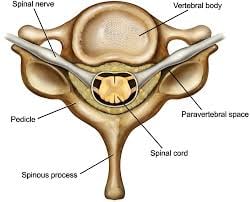
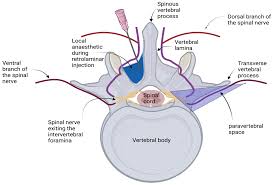
 The paravertebral space is an anatomical region located alongside the vertebral column that’s clinically important for regional anesthesia and pain management.
Anatomical boundaries: Medial space-Vertebral bodies, intervertebral discs, and intervertebral foramina
Lateral space : Parietal pleura in the thorax) or psoas muscle fascia in the lumbar region).
Contents of the Paravertebral space:
Spinal nerves as they exit the intervertebral foramina Dorsal root ganglia Sympathetic nerve fibers and ganglia of sympathetic chain Blood vessels-intercostal vessels, lumbar vessels Fatty tissue and connective tissue Lymphatic vessels
The space is commonly used for regional anesthesia, as local anesthetic is injected to block spinal nerves.
This procedure provides pain relief for: Thoracic surgery Breast surgery Rib fractures Chronic pain conditions
Provides unilateral anesthesia Lower risk of hypotension compared to epidural blocks Reduced risk of respiratory depression Can be used when epidural is contraindicated
Ultrasound or CT guidance is often used for accurate needle placement, as the space can be difficult to identify by anatomical landmarks alone.
The paravertebral space is a corridor where spinal nerves can be accessed for therapeutic interventions while avoiding the central neuraxial structures.