
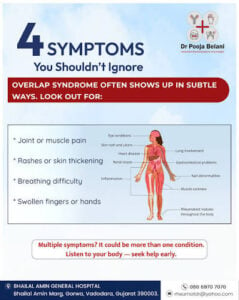
 Overlap syndrome occurs when a person has signs and lab results for two or more autoimmune or connective tissue diseases (CTDs) at the same time.
Common examples include lupus, scleroderma, and rheumatoid arthritis.
Entities satisfying classification criteria for at least two CTDs (SLE, RA, Systemic sclerosis, polymyositis/dermatomyositis, Sjögren), occurring concurrently or sequentially; specific autoantibodies often mark distinct subsets (anti-U1-RNP with MCTD; anti-Jo-1/antisynthetase; PM-Scl, Ku).
Joint pain and swelling-rheumatoid arthritis.Raynaud’s phenomenon, where fingers turn white or blue in the cold.
Muscle weakness or inflammation, known as myositis.
Skin tightness or rashes, common in scleroderma and lupus.
Blood tests look for specific autoantibodies (like anti-RNP or anti-Jo-1) that point to specific overlapping diseases.
Treatment OptionsCorticosteroids help calm down sudden and severe immune system flare-ups.Immunosuppressants are used long-term to stop the body from attacking healthy tissue.
MCTD requires high-titer anti-U1-RNP with Raynaud’s, puffy hands, arthritis, myositis, serositis, and risk of ILD and pulmonary hypertension.
Misdiagnosis is common.
Hydroxychloroquine and glucocorticoids control disease in nearly half;
DMARDs/immunosuppressants are reserved for musculoskeletal involvement, ILD, or PAH