
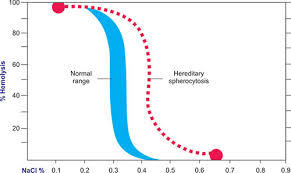
 The Osmotic Fragility Test (OFT) is a blood test used to measure how easily red blood cells (RBCs) break down/hemolyze when exposed to varying concentrations of saline solution.
OFT measures the resistance of red blood cells to hemolysis when suspended in progressively hypotonic saline solutions.
It is primarily a confirmatory test for hereditary spherocytosis, an inherited condition where RBCs are spherical rather than the normal biconcave disc shape.
The test evaluates the structural integrity of the RBC membrane and its surface-area-to-volume ratio.
The test evaluates red blood cell membrane stability and surface area-to-volume ratio by determining the extent of hemolysis at decreasing NaCl concentrations.
Spherocytes have a low surface-area-to-volume ratio and cannot swell as much as normal cells before rupturing.
This is seen in: Hereditary Spherocytosis (HS) Autoimmune hemolytic anemia Hemolytic disease of the newborn
Decreased Fragility with increased resistance:
Cells that are thinner or have a higher surface-area-to-volume ratio resist lysis longer.
This occurs in: Thalassemias Iron deficiency anemia Sickle cell anemia, especially after splenectomy Liver disease due to target cell formation
RBCs are placed in a series of hypotonic saline solutions.
Water enters the cells via osmosis, causing them to swell and eventually burst. Incubation.
Incubating the blood at 37°C for 24 hours increases the test’s sensitivity for detecting mild cases of hereditary spherocytosis.
Osmotic fragility testing cannot distinguish between spherocytes caused by hereditary conditions and those caused by autoimmune disorders.
Many modern laboratories are replacing or supplementing it with more specific tests like EMA-binding flow cytometry.
In the test, healthy erythrocytes can swell in hypotonic solutions due to their membrane redundancy and characteristic discoid shape, which provides abundant surface area relative to cell volume.
These normal cells reach their critical hemolytic volume and lyse at lower saline concentrations.
In contrast, spherocytes with reduced surface area reach their critical hemolytic volume at higher saline concentrations, making them osmotically more fragile.
The test is quantified by measuring the median osmotic fragility (MOF), defined as the NaCl concentration at which 50% of red blood cells undergo hemolysis.
Normal values are approximately 0.39-0.42% NaCl.
The incubated osmotic fragility test, performed after 24-hour incubation at 37°C, is considered the gold standard for diagnosing hereditary spherocytosis in patients with direct antiglobulin test-negative spherocytic hemolytic anemia.
Increased osmotic fragility is not unique to hereditary spherocytosis and occurs in other conditions including autoimmune hemolytic anemia, acute oxidant injury, thermal injuries, and various other hemolytic disorders.
Modern flow cytometric methods have improved the sensitivity and reproducibility of osmotic fragility testing compared to traditional spectrophotometric approaches.