
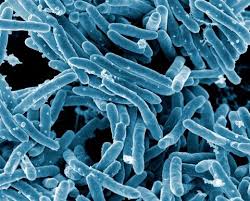
 Nontuberculous mycobacteria (NTM), also known as environmental mycobacteria, atypical mycobacteria and mycobacteria other than tuberculosis (MOTT), are mycobacteria which do not cause tuberculosis or leprosy/Hansen’s disease.
NTM can cause pulmonary diseases that resemble tuberculosis.Mycobacteriosis is any of these illnesses, usually meant to exclude tuberculosis.
They occur in many animals, including humans, and are commonly found in soil and water.
Heterogeneous group of organisms that are mostly ubiquitous and found in soil, food, water, and animals.
There are more than 150 species of nontuberculosis mycobacteria (NTM).
Only a small subset of nontuberculosis mycobacteria are known to cause disease in humans.
Notable for environmental to human transmission.
Prevalence is increasing.
It is estimated there more than 80,000 people in the US currently living with pulmonary NTM diseases.
Increased rate in NTM infections may be due to improved clinical recognition, improved laboratory diagnostic capabilities in immunocompromised and immunocompetent patients.
Many NTM is that infections are resistant to antimicrobial agents.
Risk of acquired drug resistance and slow growing nature of the NTM compared with other bacterial pathogens, combination antibiotic therapy is generally recommended for prolonged periods of time.
M. avium is the most commonly identified non-tuberculosis mycobacteria.
Nontuberculosis mycobacteria infection typically occurs in patients with underlying disease: bronchiectasis, dysregulation of immunity, specifically involving T cells (HIV) or interferon gamma (TNF-alpha inhibitors).
Treatment of nontuberculousismycobacteria involves prolonged course of several antibiotics: Azithromycin, ethambutal and rifampin.
Mycobacteria are a family of small, rod-shaped bacilli that can be classified into three main groups for diagnosis and treatment:
Mycobacterium tuberculosis complex, which can cause tuberculosis: M. tuberculosis, M. bovis, M. africanum, M. microti and M. canettii, M. leprae and M. lepromatosis, which cause Hansen’s disease, also called leprosy.
Nontuberculous mycobacteria (NTM) are all the other mycobacteria that can cause pulmonary disease resembling tuberculosis, lymphadenitis, skin disease, or disseminated disease.
Over 150 different species of NTM have been described, pulmonary infections are most commonly due to Mycobacterium avium complex (MAC), Mycobacterium kansasii, and Mycobacterium abscessus.
These human disease-associated bacteria into four groups (Runyon classification):
Photochromogens develop pigments in or after being exposed to light: M. kansasii, M. simiae, and M. marinum.
Scotochromogens become pigmented in darkness: M. scrofulaceum and M. szulgai.
Nonchromogens include a group of prevalent opportunistic pathogens called M. avium complex (MAC).
Other examples are M. ulcerans, M. xenopi, M. malmoense, M. terrae, M. haemophilum, and M. genavense.
Rapid growers include four well-recognized, pathogenic, rapidly growing, nonchromogenic species: M. chelonae, M. abscessus, M. fortuitum, and M. peregrinum.
Other examples cause disease rarely, such as M. smegmatis and M. flavescens.
NTM are widely distributed in the environment, particularly in wet soil, marshland, streams, rivers, and estuaries.
Human disease is believed to be acquired from environmental exposures.
Unlike tuberculosis and leprosy, animal-to-human or human-to-human transmission of NTM rarely occurs.
NTM diseases have been seen in most industrialized countries, where incidence rates vary from 1.0 to 1.8 cases per 100,000 persons.
Pulmonary NTM is estimated by some experts in the field to be at least ten times more common than TB in the U.S., with at least 150,000 cases per year.
Most NTM disease cases involve the species known as Mycobacterium avium complex or MAC for short, M. abscessus, M. fortuitum and M. kansasii.
M. abscessus is being seen with increasing frequency and is particularly difficult to treat.
M. chelonae infection outbreaks, as a consequence of tattooing with infected ink, have been reported in the United Kingdom[12] and the United States.
Rapidly growing NTMs are implicated in catheter infections, post-LASIK, skin and soft tissue, especially post-cosmetic surgery, and pulmonary infections.
The most common clinical manifestation of NTM disease is lung disease, but lymphatic, skin/soft tissue, and disseminated diseases are also important.
Pulmonary disease caused by NTM is most often seen in postmenopausal women and patients with underlying lung diseases such as cystic fibrosis, bronchiectasis, and prior tuberculosis.
It is not uncommon for alpha 1-antitrypsin deficiency, Marfan syndrome, and primary ciliary dyskinesia patients to have pulmonary NTM colonization and/or infection.
Pulmonary NTM can also be found in individuals with AIDS and malignant disease.
It can be caused by many NTM species, which depends on region, but most frequently MAC and M. kansasii.
Clinical symptoms commonly include chronic cough, often with purulent sputum.
Hemoptysis may also be present.
Systemic symptoms include malaise, fatigue, and weight loss in advanced disease.
The diagnosis of M. abscessus pulmonary infection requires the presence of symptoms, radiologic abnormalities, and microbiologic cultures.
Lymphadenitis can be caused by various species:MAC is the main cause worldwide.
Most patients are aged less than 5 years, but the incidence is rare for children having BCG vaccine.
Soft-tissue disease due to NTM infection include post-traumatic abscesses, and.
Disseminated mycobacterial disease was common in US and European AIDS patients in the 1980s and early 1990s, though the incidence has declined in developed nations since the introduction of highly active antiretroviral therapy. It can also occur in individuals after having renal transplantation.
Diagnosis of opportunistic mycobacteria is made by repeated isolation and identification of the pathogen with compatible clinical and radiological features.
Similar to M. tuberculosis, most nontuberculous mycobacteria can be detected microscopically and grow on Löwenstein-Jensen medium.
Pulmonary NTM disease diagnosis requires both identification of the mycobacterium in the patient’s lungs, as well as a high-resolution CT scan of the lungs.
Nonmycobacterium tuberculosis refers to mycobacterial species other than Mycobacterium tuberculosis complex.
These are commonly called nontuberculous mycobacteria (NTM) or atypical mycobacteria.
Common species: M. avium complex (MAC) – most common cause of NTM lung disease M kansasii – causes lung disease similar to TB M. abscessus – rapidly growing, often antibiotic-resistant M. marinum – causes skin infections (“fish tank granuloma”) M. fortuitum – rapidly growing, skin and soft tissue infections
NTM can cause various infections including pulmonary disease, lymphadenitis in children, skin and soft tissue infections, and disseminated disease in immunocompromised patients.
Diagnosis challenges include:
Often environmental contaminants vs. true pathogens Require specific criteria guidelines) to distinguish colonization from infection Need multiple positive cultures for diagnosis Acid-fast staining positive but different from TB
Treatment differences: More antibiotic-resistant than TB Often require prolonged combination therapy Treatment regimens vary significantly by species Some species (M. abscessus) are particularly difficult to treat
A