
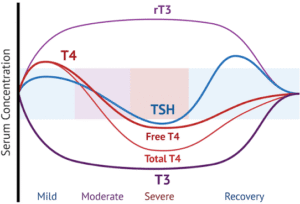
 Non-thyroidal illness syndrome (NTIS) — also called euthyroid sick syndrome, sick euthyroid syndrome, or low-T3 syndrome — refers to alterations in circulating thyroid hormones that occur during acute or chronic systemic illness in the absence of intrinsic hypothalamic-pituitary-thyroid (HPT) axis disease.
The biochemical hallmark is a low serum T3 with an inappropriately normal (or low-normal) TSH, often accompanied by elevated reverse T3 (rT3) and, in more severe illness, a fall in T4/free T4.
It is extremely common, affecting the majority of patients admitted to any general hospital and nearly all critically ill patients.
Low T3 is the earliest and most consistent change, appearing within hours of acute stress (e.g., a fall in T3 within 2 hours of abdominal surgery).
Elevated rT3, resulting from shunting of T4 metabolism toward inactivation, which helps distinguish NTIS from true hypothyroidism (where rT3 is low).
Low or low-normal T4/FT4 emerges with increasing severity and duration of illness.
TSH remains within or slightly below the reference range, deviating from the expected negative-feedback rise that would occur in primary hypothyroidism.
Pathophysiology — NTIS reflects multilevel suppression of the HPT axis combined with altered peripheral hormone metabolism:
Central downregulation: decreased hypothalamic TRH expression in the paraventricular nucleus and reduced pituitary TSH secretion; fasting/caloric deprivation amplifies this via falling leptin and neuropeptide-Y–mediated TRH suppression.
Altered deiodinase activity: decreased outer-ring deiodination (D1/D2) reduces T4→T3 conversion, while increased type 3 deiodinase (D3) accelerates inactivation of T4 and T3, raising rT3.
Cytokines (IL-6, TNF-α) and oxidative stress released during illness are considered major drivers of these changes.
Acute vs. chronic phase — In the early/acute phase, changes are dominated by peripheral metabolism shifts and are widely interpreted as an adaptive, energy-conserving response.
In prolonged critical illness, altered central feedback predominates, and the low-hormone state is more strongly linked to adverse outcomes.
Whether this represents beneficial adaptation or maladaptive contribution to poor outcomes remains debated.
Prognostic significance — The magnitude of thyroid hormone reduction correlates with illness severity and mortality.
Low T3 predicts poor outcomes in cardiac disease, sepsis, liver failure, and COVID-19; serum T4 <40 nmol/L in the ICU predicted mortality with ~75% sensitivity and 80% specificity, rising to 100% sensitivity when combined with high cortisol.
In myocardial infarction, T3 decline correlates with infarct size.
Distinguishing NTIS from true thyroid disease — This is the key clinical task, since misdiagnosis can lead to unnecessary or harmful treatment:
Central hypothyroidism can mimic NTIS (low FT4, non-elevated TSH); clues favoring NTIS include the acute illness context, elevated rT3, and elevated cortisol, whereas true pituitary disease typically involves deficiencies of other pituitary hormones.
Timing of testing matters: during recovery, TSH may transiently rise, mimicking primary hypothyroidism. Ideally, defer nonurgent thyroid testing in acutely ill patients unless thyroid dysfunction is genuinely suspected.
Management — No thyroid hormone replacement is indicated in NTIS.
There is no evidence that T4 or T3 supplementation improves outcomes in critically ill patients, and hormone changes normalize spontaneously with recovery of the underlying illness.
Treatment is directed at the underlying disease.