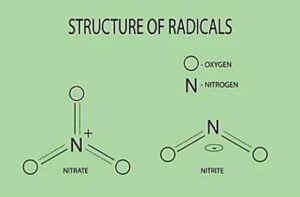
 Nitrates (NO₃⁻) and nitrites (NO₂⁻) are naturally occurring nitrogen compounds found in soil, water, plants, and the human body as part of the nitrogen cycle.
Nitrates and nitrites are naturally occurring nitrogen compounds found in vegetables, soil, and water, and are also used in curing some meats.
They are also used as food additives.
Bacteria in the mouth convert dietary nitrates to nitrites; nitrites can further form nitric oxide (beneficial) or, under certain conditions, N-nitrosamines (potentially harmful).
The practical distinction is that vegetable-derived nitrate is generally compatible with a healthy diet, while elevated drinking-water nitrate is a concern—especially for young infants—and frequent processed-meat intake should be minimized.
Nitrate (NO3) is relatively less reactive.
Nitrite (NO2) more reactive.
It occurs naturally in leafy greens, beetroot, celery, soil, and groundwater; agricultural fertilizer/manure, septic systems, and wastewater can raise groundwater concentrations.
Main Sources Vegetables (primary dietary source, ~70–80% of intake): Leafy greens (spinach, lettuce, arugula/rocket, kale), beets, celery, radishes, and some root vegetables.
Levels vary with soil, fertilizer use, and growing conditions.
Oral bacteria and the gut can reduce nitrate to nitrite; nitrite is also intentionally used in cured meats for color, flavor, oxidative stability, and control of pathogens including Clostridium botulinum.
In humans, the nitrate → nitrite → nitric oxide pathway can contribute to vascular signaling.
That biology is one reason nitrate-rich vegetables should not be treated as nutritionally equivalent to cured meat.
Food: source matters.
Leafy greens, beets, celery, other vegetables are part of a vegetable-rich dietary pattern.
Vegetable nitrate comes with fiber, potassium, vitamin C, and polyphenols; typical consumption of about 400 g/day mixed fruit and vegetables is not expected to exceed EFSA’s nitrate ADI for an average consumer.
Concentrated products can deliver far more nitrate than usual food; quality, dose, medications, renal function, and hypotension risk matter.
Cured/processed meats—bacon, ham, hot dogs, sausages, deli meats.
Uncured does not necessarily mean nitrite-free in effect.
Nitrite/nitrate helps food safety, but processed meats may also favor formation of N-nitroso compounds under some conditions; processed-meat intake is the more important prevention concern, rather than nitrate in vegetables.
Processed/cured meats: Bacon, ham, hot dogs, sausages, deli meats, and similar products.
Sodium or potassium nitrite/nitrate is added for color, flavor, and to inhibit Clostridium botulinum (botulism risk).
Naturally curedproducts often use celery powder or juice, which supplies concentrated plant nitrates that convert similarly.
Drinking water is safe when tested and below the relevant standard; test private wells.
Unlike vegetables, water can deliver nitrate without protective food-matrix components and may reach clinically important concentrations.
“Natural” or “uncured” cured meats often use celery powder/juice as a nitrate source, which can subsequently yield nitrite.
Health effects:
Methemoglobinemia: key acute risk After nitrate is converted to nitrite, nitrite can oxidize hemoglobin iron and produce methemoglobin, reducing oxygen delivery.
Benefits come mainly from plant sources via the nitrate–nitrite–nitric oxide pathway.
Nitric oxide promotes vasodilation, which can lower blood pressure, improve endothelial function, and support blood flow.
NItric oxide associated with better exercise performance and reduced cardiovascular disease risk in observational and some intervention studies: moderate vegetable nitrate intake ~60 mg/day linked to lower CVD risk.
The classic high-risk population is young infants, particularly formula-fed infants exposed to nitrate-contaminated well water.
Symptoms can include cyanosis, lethargy, poor feeding, dyspnea, tachycardia, or altered mental status; this is an urgent evaluation scenario.
Infants younger than 6 months who consume water exceeding nitrate or nitrite standards can become seriously ill and may die without treatment.
Risk is also higher with enteric infection, significant inflammation, impaired gastric acidity, and certain inherited or acquired causes of methemoglobinemia.
Cancer and cardiometabolic context
Nitrite can participate in formation of N-nitroso compounds, especially in processed-meat contexts and under conditions that favor nitrosation.
Conversely, vitamin C and plant polyphenols can inhibit nitrosamine formation, and vegetables have broader health benefits.
Health messaging:
Eat nitrate-containing vegetables freely. Limit processed meat as a food-pattern intervention. Do not use untested private-well water for infant formula.
Vegetables supply antioxidants (vitamin C, polyphenols) and fiber that favor beneficial conversion and inhibit nitrosamine formation.
Water standards
Drinking water: Usually a minor contributor (<14% of intake) unless contaminated by agricultural fertilizer runoff, manure, or sewage.
Drinking water limits (U.S. EPA):
• Nitrate: 10 mg/L (measured as nitrogen, “NO₃-N”) • Nitrite: 1 mg/L (as nitrogen) • Combined nitrate + nitrite: 10 mg/L (as nitrogen)
U.S. EPA: Maximum Contaminant Level (MCL) 10 mg/L nitrate as nitrogen (~44 mg/L as nitrate) and 1 mg/L nitrite as nitrogen.
WHO: 50 mg/L as nitrate ion and 3 mg/L as nitrite ion.
WHO guidelines are expressed differently: 50 mg/L nitrate (as nitrate) and 3 mg/L nitrite (as nitrite) for short-term exposure. 50 mg/L as nitrate is roughly 11 mg/L as nitrogen, so the two standards are close once you convert.
Acceptable Daily Intake (~3.7 mg/kg body weight/day for nitrate and 0.07 mg/kg body weight/day for nitrite.
The main risk is for infants under 6 months, where high levels can cause methemoglobinemia (“blue baby syndrome”).
If water tests above 10 mg/L nitrate-N, it is not used for formula or given to infants.
Adults and older children are far less susceptible at typical exposures.
Boiling concentrates nitrate rather than removing it.
Reverse osmosis, ion exchange, or distillation does remove it.
Practical actions
If using a private well, arrange laboratory nitrate/nitrite testing at least annually and whenever flooding, a nearby septic-system failure, fertilizer/manure application, change in taste/odor, or pregnancy/infant use raises concern.
For water used to prepare infant formula, use a known-safe tested supply.
Boiling does not remove nitrate; it can concentrate it as water evaporates.
Public water systems are regulated and report contaminant monitoring, but a home filter should not be assumed to address nitrate.
Effective options commonly include properly maintained reverse osmosis, ion exchange, or distillation; ordinary carbon filters and boiling are not reliable nitrate-removal strategies.
For diet, prioritize vegetables—including leafy greens and beets—and reduce processed meats rather than avoiding all dietary nitrate.
If a well-water result is above standard, avoid using it for infant formula and seek local public-health or water-treatment guidance promptly.
Private wells in farming areas are higher risk.
Smaller amounts occur in some cheeses and form endogenously in the body.
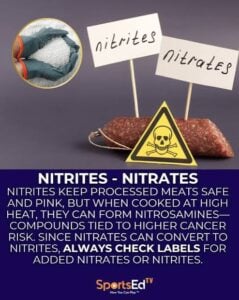
Nitrosamine formation and cancer: Nitrites can react with amines from proteins under acidic stomach conditions, high heat cooking, or certain bacterial presence to form N-nitrosamines, some of which are carcinogenic.
The International Agency for Research on Cancer (IARC) classifies ingested nitrate/nitrite under conditions that result in endogenous nitrosation as probably carcinogenic to humans.
Evidence is stronger for processed meats (linked to colorectal and stomach cancers) than for vegetables; plant matrix components inhibit nitrosamine formation, and vegetable-rich diets are generally associated with lower cancer risk.
High water nitrate has been linked in some studies to certain cancers, though evidence is mixed and often confounded by other factors.
Processed meats carry additional risks due to high sodium, saturated fat, other compounds from smoking/curing) beyond nitrates/nitrites alone.
Removing these additives without alternative preservation methods raises food-safety concerns, such as botulism risk.
Food additives: Strict limits on residual levels in cured meats, USDA typically ≤200 ppm sodium nitrite, ≤500 ppm sodium nitrate in finished product.
Most people do not exceed safe levels from a normal mixed diet.
High consumers of leafy vegetables can approach or exceed the nitrate acceptable daily intake but this is generally not considered problematic because of the protective food matrix.
Health recommendations:
Prioritizing vegetables: The health benefits of nitrate-rich produce outweigh theoretical risks for the general population.
Limit processed meats: Follow guidelines such as keeping red + processed meat to ≤70 g/day on average or similar moderate intake.
Check water: Test private wells, especially in agricultural areas or if there are infants in the household. Public supplies are monitored against standards.
Cooking: High-heat methods (grilling, frying) of cured meats can increase nitrosamine formation; antioxidants (e.g., vitamin C-rich foods) help counteract this.
Special groups: Infants, pregnant people, and those with certain gastrointestinal conditions warrant extra caution with high-nitrate water.
Plant-derived nitrates are part of a healthy diet and linked to cardiovascular benefits, while high intakes of processed meats are associated with elevated cancer and other risks.
Balanced eating—plenty of vegetables, limited cured meats, and safe water—addresses the main concerns without needing to eliminate these compounds entirely.