
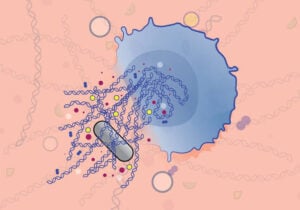
 Neutrophil extracellular traps (NETs) are web-like networks of DNA, histones, and antimicrobial proteins released by neutrophils to immobilize and destroy invading pathogens.
Neutrophils expel their own chromatin (DNA + proteins) to form a neutrophil extracellular trap (NET) — a net-like structure that captures invading pathogens and can trigger clotting to wall off an area of the body. 
NETosis is a specialized form of cell death and immune defense unique to neutrophils — the frontline cells of the immune system.
Key biochemical trigger: The induction of NETosis depends on reactive oxygen species (ROS), the main source of which is NADPH oxidase.
During the process, the neutrophil’s nucleus loses its normal shape, its membranes fragment into vesicles, granule membranes rupture, and nuclear, cytoplasmic, and granular contents mix together — then the plasma membrane opens and the NET is released into the extracellular space. 
It’s crucial for fighting bacterial, viral, and fungal infections.
While vital for fighting infections, excessive NET formation can damage host tissues and drive autoimmune, inflammatory, and thrombotic diseases.
While the mechanism is crucial for combating infections, it’s also associated with various disorders such as asthma, atherosclerosis, and cancer metastasis. 
They represent a distinct form of neutrophil-mediated immunity beyond phagocytosis.
NETs primarily consist of unwound, decondensed chromatin (DNA) that forms a large web.
The DNA mesh is heavily decorated with antimicrobial molecules from the neutrophil’s granules, including histones, myeloperoxidase (MPO), and neutrophil elastase.
These structures trap microorganisms—such as bacteria, fungi, and viruses—and neutralize their virulence factors, limiting the spread of infection.
NETosis is a specialized process of a neutrophil self-destructing to expel its DNA and form these traps.
In a healthy immune response, NETs are highly protective.
When dysregulated or excessive NET formation occurs it acts as a “double-edged sword” and is heavily implicated in several pathological conditions.
Thrombosis: NETs act as a structural scaffold that promotes blood clotting and can trigger deep vein thrombosis or stroke.
Autoimmune Diseases: Exposure of self-DNA and histones can fuel autoimmune reactions, playing a prominent role in conditions like lupus.Inflammation: The enzymes embedded in NETs can degrade host tissue, contributing to acute respiratory distress syndrome (ARDS), sepsis, and chronic inflammation.
Cancer: Emerging research indicates that the tumor microenvironment can trigger NETs, which can unfortunately aid in tumor progression and metastasis.
NETs can form via two main pathways:
Suicidal (classical) NETosis — leads to cell death.
Suicidal NETosis: The classical pathway, taking 3–4 hours. Involves NADPH oxidase-dependent ROS production, granule dissolution, nuclear decondensation, and rupture of the plasma membrane — releasing NETs and killing the neutrophil.
Vital NETosis — the neutrophil survives and retains its other immune functions. 
Vital NETosis: Neutrophil remains viable and can still phagocytose. NET release occurs via vesicular budding, often triggered by TLR or platelet activation.
NETosis is a major link between inflammation, immunity, coagulation, and hemostasis.
Composition
The NET scaffold is primarily chromatin (DNA + histones), decorated with:
Neutrophil elastase (NE) Myeloperoxidase (MPO) Cathepsin G Proteinase 3 Calprotectin, lactoferrin, defensins
Physiological Role
NETs trap bacteria, fungi (Candida, Aspergillus), viruses, and parasites — particularly large pathogens too big to phagocytose.
They concentrate antimicrobial proteins at the site of infection.
In lupus excessive NET production and/or reduced NET clearance contributes to autoimmune pathology — the released nuclear antigens can become autoantigens, breaking down self-tolerance. 
Excessive or dysregulated NETosis contributes to a wide range of diseases:
Disease Category
Autoimmune |SLE, rheumatoid arthritis, vasculitis | Thrombosis DVT, stroke, MI — NETs provide a scaffold for clot formation
Sepsis Organ damage from NET-mediated inflammation
Cancer Tumor progression, metastasis, cancer-associated thrombosis
COVID-19 |Immunothrombosis, ARDS
Diabetes |Impaired wound healing, vascular damage
NETs and Thrombosis
NETs activate platelets, provide a scaffold for fibrin deposition, and trap red blood cells — directly promoting thrombus formation.
This crosstalk is termed immunothrombosis.
Therapeutic Targeting
DNase I — degrades the NET scaffold
PAD4 inhibitors — block histone citrullination and NET formation.
Anti-MPO / anti-NE antibodies
NADPH oxidase inhibitors
Heparin and other anticoagulants that disrupt NET-platelet interactions