
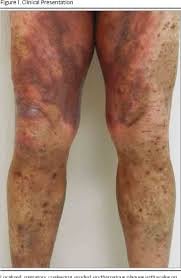
Necrolytic migratory erythema (NME) is a rare, painful skin rash that is a hallmark sign of glucagonoma syndrome, typically caused by a slow-growing tumor in the pancreas.
It appears in roughly 70% to 90% of patients with these tumors.
The rash starts as red, well-demarcated patches or plaques that blister centrally.
These blisters then erode, crust over, and heal with hyperpigmention.
It is migratory as the edges often expand outward in a ring-like or snake-like (serpiginous) pattern while the center heals.
It most commonly affects areas prone to friction and pressure, including:
Groin, genitals, and buttocks
Perioral
Lower legs and distal extremities
It is frequently accompanied by intense itching or a burning sensation.
NME often appears alongside other systemic signs, sometimes called the “4 Ds”:
Dermatosis: Specifically this characteristic NME rash. Diabetes: New-onset or worsening high blood sugar. Deep Vein Thrombosis (DVT): A high risk for blood clots. Depression: Or other neuropsychiatric changes.
Other common signs: Unexplained weight loss, diarrhea, anemia, and a sore, “beefy red” tongue.
The rash is most often triggered by a glucagonoma, a rare pancreatic tumor that produces excessive glucagon.
This excess hormone leads to nutritional deficiencies—specifically in zinc, amino acids, and essential fatty acids—which are believed to cause the skin to break down.
Pseudoglucagonoma Syndrome: In rare cases, NME occurs without a tumor, instead linked to liver disease (cirrhosis), celiac disease, or severe inflammatory bowel disease.
It is frequently misdiagnosed as eczema, psoriasis, or fungal infections.
Correct diagnosis typically requires:
Skin Biopsy: To look for characteristic superficial epidermal necrosis. Blood Tests: To check for extremely high glucagon levels and low amino acids. Imaging: Such as a CT scan or MRI to identify a glucagonoma of the pancreas.
Treatment focuses on the underlying cause.
Surgical removal of the pancreatic tumor often results in the rash clearing completely within days.
For those who cannot have surgery, somatostatin analogs like and nutritional supplements (zinc and amino acids) can help manage the rash.