
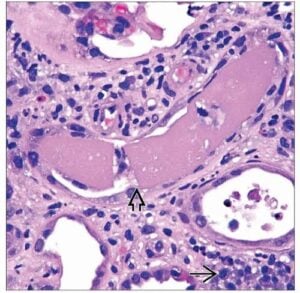
 Myeloma-related kidney disease is one of the most common and prognostically important complications of multiple myeloma, affecting 20–50% of patients, with acute kidney injury (AKI) present at diagnosis in roughly 30%.
The dominant lesion is light-chain myeloma- cast nephropathy.
Myeloma kidney is also called myeloma cast nephropathy or light chain cast nephropathy, and is the most common form of kidney injury linked to multiple myeloma.
Kidney impairment affects 20–50% of patients with multiple myeloma at diagnosis and roughly 2–13% require dialysis at presentation.
Cast nephropathy is found in 40–60% of kidney biopsies performed in myeloma patients with renal disease.
AKI or progressive chronic kidney disease (CKD) worsens prognosis and increases early mortality risk, though recovery of kidney function largely reverses this impact with modern therapy.
It is a myeloma-defining event and a leading cause of acute kidney injury (AKI) in these patients.
The term “myeloma kidney” encompasses several distinct mechanisms of monoclonal immunoglobulin nephrotoxicity, and management hinges on rapid, deep suppression of the nephrotoxic free light chain (FLC) with anti-myeloma therapy.
Cast nephropathy-Filtered monoclonal FLCs bind uromodulin (Tamm–Horsfall protein) in the distal tubule, forming obstructive casts that cause intraluminal obstruction, tubulointerstitial inflammation, and acute tubular injury.
Multiple myeloma produces excess monoclonal free light chains (Bence Jones proteins).
These freely filter through the glomeruli.
When production overwhelms proximal tubule reabsorption capacity, the light chains reach the distal nephron and bind to Tamm-Horsfall protein (uromodulin).
This forms obstructive intratubular casts that block urine flow, trigger inflammation, and lead to tubular damage, interstitial fibrosis, and reduced kidney function.
This requires high FLC production, typically involved serum FLC >150 mg/dL, and occurs almost exclusively with a high tumor burden as with multiple myeloma, high-grade B-cell disorders.
Light-chain proximal tubulopathy: Reabsorbed FLCs accumulate in proximal tubular cells, sometimes forming crystals, causing lysosomal dysfunction, Fanconi syndrome, and tubular injury.
Light chains can also cause direct proximal tubular toxicity, Fanconi syndrome, or other patterns-light-chain deposition disease or AL amyloidosis, but “myeloma kidney” specifically refers to the cast nephropathy pattern.
Glomerular/deposition diseases: AL amyloidosis, light-chain deposition disease (MIDD), and others — typically low tumor burden, presenting with albuminuria/nephrotic-range proteinuria rather than isolated light-chain proteinuria.
Contributing or precipitating factors include: Dehydration / low urine flow Hypercalcemia (common from bone involvement) NSAIDs Radiocontrast agents Hyperuricemia Loop diuretics Infection or sepsis
Predominant light-chain proteinuria with high serum FLC points to cast nephropathy, whereas prominent albuminuria/nephrotic-range proteinuria points to a glomerular/deposition process and warrants renal biopsy.
Patients often present with AKI alongside typical myeloma features (bone pain, anemia, hypercalcemia, infections).
Kidney-related signs may include reduced urine output, edema, fatigue, nausea, or frothy urine.
Urinalysis is typically bland with few cells or casts visible on microscopy.
Dipstick for protein may under-detect proteinuria because it primarily detects albumin, while light-chain proteinuria predominates.
Diagnostic workup patients should have serum creatinine and eGFR (CKD-EPI preferred for stabilized creatinine), electrolytes, calcium, uric acid, urinalysis with sediment, 24-hour urine for total protein with UPEP/UIFE, SPEP/SIFE, and serum FLC assay.
Key tests: Serum free light chain (FLC) assay — levels are often markedly elevated (commonly ≥500–1,500 mg/L supports the diagnosis).
Serum and urine protein electrophoresis + immunofixation.
24-hour urine protein quantification (light-chain predominant).
Standard labs: creatinine, eGFR, calcium, electrolytes.
A presumptive diagnosis of light-chain cast nephropathy is often made without biopsy when there is AKI + high serum FLC + light-chain–dominant proteinuria.
Kidney biopsy is reserved for atypical cases (significant albuminuria, lower FLC levels, uncertainty about alternative diagnoses such as amyloidosis or other monoclonal gammopathy–related kidney diseases).
Renal biopsy is indicated when the diagnosis is uncertain — notably with non-selective/albuminuric proteinuria or when involved serum FLC is <500 mg/L, since >15% of AKI in myeloma is not attributable to cast nephropathy.
Management
The cornerstone is prompt anti-myeloma therapy plus aggressive supportive care, because renal recovery correlates directly with the speed and depth of FLC reduction — a clinically significant FLC drop within ~3 weeks predicts full or partial renal recovery.
Rapid reduction of circulating free light chains is the priority, combined with supportive measures.
Supportive measures (per NCCN):
Aggressive intravenous hydration to maintain high urine flow.
Vigorous hydration to dilute tubular light chains, targeting urine output of 100–150 cc/h, with fluid-status monitoring.
Correct hypercalcemia and other electrolyte issues.
Strictly avoid nephrotoxins (NSAIDs, unnecessary contrast, etc.), and renally dose all medications.
Treat infections promptly.
Dialysis if indicated for severe fluid/electrolyte complications or uremia.
Anti-myeloma therapy:
Bortezomib-based regimens with high-dose dexamethasone are the standard of care and the backbone of treatment; bortezomib requires no renal dose adjustment and produces rapid FLC reduction.
High-dose dexamethasone should be given at least for the first month.
Modern quadruplet/triplet regimens incorporating anti-CD38 monoclonal antibodies (daratumumab) improve renal and survival outcomes.
Carfilzomib can be used with CrCl >15 mL/min; ixazomib with lenalidomide/dexamethasone requires CrCl >30 mL/min.
Lenalidomide requires renal dose adjustment (10 mg daily for CrCl 30–<60; 15 mg every 48 h for CrCl <30 not on dialysis; 5 mg daily post-dialysis for ESRD).
Mechanical FLC removal — high-cutoff hemodialysis or plasma exchange — has at most a limited role and does not improve overall survival; systemic therapy must not be delayed for it.
Renal recovery is driven by hematologic response, not extracorporeal clearance — achieving a predialysis FLC <500 mg/L after the first cycle is an independent predictor of dialysis independence.
Any degree of renal impairment in newly diagnosed myeloma is associated with worse overall survival, and cast nephropathy has been linked to early mortality (6-month early death rate historically 16–23%).
However, modern RX and anti-CD38–based regimens have substantially improved both renal recovery and survival, and renal response itself reduces mortality risk.
Anti-myeloma therapy Bortezomib-based regimens (proteasome inhibitor) plus high-dose dexamethasone form the cornerstone; bortezomib does not require major dose adjustment for kidney impairment.
Modern triplets or quadruplets often add an anti-CD38 monoclonal antibody (e.g., daratumumab or isatuximab) ± cyclophosphamide or an immunomodulatory drug.
Goal: achieve substantial FLC reduction early (e.g., <50 mg/dL after the first cycle is a favorable predictor of dialysis independence.
Extracorporeal removal of light chains (therapeutic plasma exchange or high-cutoff hemodialysis) has been studied but is not routinely recommended as standard first-line therapy on top of modern chemotherapy; evidence of clear survival or renal-outcome benefit remains mixed.
Modern regimens produce high rates of renal recovery.
Recent real-world data show overall renal response rates around 70–80% and complete renal responses in roughly one-third of patients at 6 months, with low early mortality when treatment starts promptly.
Persistent dialysis dependence remains the strongest negative prognostic factor.
Many patients who initially require dialysis can become independent.
Kidney transplantation may be considered in carefully selected patients who achieve deep, sustained myeloma remission, though data remain limited.
Myeloma kidney is a medical emergency requiring rapid diagnosis and treatment focused on lowering free light chains while protecting remaining kidney function.
With contemporary anti-myeloma therapy, meaningful renal recovery is achievable in the majority of patients and substantially improves overall prognosis.