
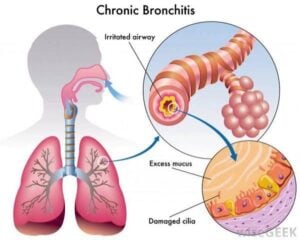
 Mucolytic therapy breaks down mucus to make it easier to clear from the airways — used in conditions like COPD, cystic fibrosis, bronchiectasis, and chronic bronchitis.
Mucolytic (mucoactive) therapy encompasses drugs that alter the physical or chemical properties of airway secretions to improve clearance, and the choice of agent and expected benefit depend heavily on the underlying disease.
Agents:
These agents are broadly classified into true mucolytics which decrease viscosity, mucokinetics that increase mucus transport, and expectorants/hydrators which decrease adhesiveness by increasing airway surface liquid, though in practice most agents act through several mechanisms and the terms are used interchangeably.
Thiol-based agents (N-acetylcysteine, carbocisteine, erdosteine) — break disulfide bonds linking mucin monomers, lowering viscosity; they also have antioxidant, anti-inflammatory, and antibacterial properties.
N-acetylcysteine (NAC)– breaks disulfide bonds in mucus proteins; oral or nebulized.
Dornase alfa (Pulmozyme)– enzyme that breaks down DNA in mucus; mainly for cystic fibrosis
Dornase alfa (recombinant human DNase, Pulmozyme) — an inhaled enzyme that degrades extracellular DNA from neutrophils, reducing the tenacity of purulent mucus.
Hypertonic saline– draws water into airways to thin secretions, often nebulized.
Guaifenesin– oral expectorant, thins mucus so it’s easier to cough up
Bromhexine/ambroxol– used in some countries, not FDA-approved in the US
Ambroxol and bromhexine — stimulate surfactant secretion and enhance mucociliary clearance, making sputum less adhesive.
Carbocisteine– alters mucus consistency, common in Europe/Asia.
Carbocisteine additionally modulates mucin glycosylation and chloride transport.
That are often paired with airway clearance techniques (chest physiotherapy, huff coughing, oscillating PEP devices).
Many are given before physical clearance techniques so loosened mucus can actually be expelled.
Hydration also supports mucus thinning generally
Hydrators/hyperosmolar agents (hypertonic saline, inhaled mannitol) — increase airway surface hydration to aid detachment and clearance.
Not all mucolytics help all conditions — evidence is strongest for CF (dornase alfa) and moderate for COPD (NAC, carbocisteine) as maintenance therapy.
Can occasionally trigger bronchospasm, especially nebulized hypertonic saline — bronchodilator pretreatment is sometimes used.
Suggest an oral mucolytic to prevent future exacerbations in patients with moderate-to-severe airflow obstruction and exacerbations despite optimal inhaled therapy; high-dose (e.g., NAC 600 mg twice daily) appears more effective than low-dose.
Mucolytics may reduce exacerbations and modestly improve health status, particularly in patients not on ICS, but evidence to target the population most likely to benefit is lacking.
Considered for patients with chronic productive cough and continue only if symptoms improve; do not routinely prescribe to prevent exacerbations.
A 2019 Cochrane meta-analysis found a small increase in exacerbation-free likelihood with mucolytics, but with high heterogeneity, diminishing effect sizes in newer trials, quality-of-life gains below the minimal clinically important difference, and no clear mortality effect.
A 2024 trial of high-dose NAC (1200 mg/day) in mild-to-moderate COPD found no significant reduction in exacerbations, reinforcing the importance of patient selection.
Dornase alfa should not be used outside CF — it worsened lung function and exacerbation rates and is reported to increase mortality in non-CF disease.
Guaifenesin is ineffective as an expectorant for sputum retention.