
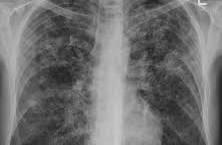
 Miliary tuberculosis-Other names Disseminated tuberculosis, tuberculosis cutis acuta generalisata, tuberculosis cutis disseminata.
Miliary tuberculosis is a form of tuberculosis that is characterized by a wide dissemination into the human body and by the tiny size of the lesions (1–5 mm).
Miliary tuberculosis is a form of tuberculosis that is the result of Mycobacterium tuberculosis travelling to extrapulmonary organs, such as the liver, spleen and kidneys.
There is a distinctive pattern seen on a chest radiograph of many tiny spots distributed throughout the lung fields with the appearance similar to millet seeds—thus the term “miliary” tuberculosis.
Miliary TB may infect any number of organs, including the lungs, liver, and spleen.
Patients with miliary tuberculosis often experience non-specific signs, such as coughing and enlarged lymph nodes.
Miliary tuberculosis can also present with hepatmegaly (40% of cases), splenomegaly (15%), pancreatitis (<5%), and multiple organ dysfunction with adrenal insufficiency, and diarrhea.
Other symptoms include fevers, hypercalcemia, choroidal tubercles, and cutaneous lesions.
Hypercalcemia seen in 16–51% of tuberculosis cases, a response to increased macrophage activity in the body.
Such that, 1,25 dihydroxycholecalciferol (calcitriol) improves the ability of macrophages to kill bacteria; however, but the higher levels of calcitriol lead to higher calcium levels, and thus hypercalcemia in some cases.
Thirdly, chorodial tubercules, pale lesions on the optic nerve, typically indicate miliary tuberculosis in children.
Chorodial tubercules may serve as important symptoms of miliary tuberculosis, since their presence can often confirm suspected diagnosis.
10–30% of adults and 20–40% of children with miliary tuberculosis have tuberculosis meningitis.
Mycobacteria from miliary tuberculosis spreading to the brain and the subarachnoid space; as a result, leading to tuberculosis meningitis.
A proposed mechanism of miliary TB is that tuberculous infection in the lungs results in erosion of the epithelial layer of alveolar cells and the spread of infection into a pulmonary vein.
Once the bacteria reach the left side of the heart and enter the systemic circulation, they may multiply and infect extrapulmonary organs.
Once infected, the cell-mediated immune response is activated, and the infected sites become surrounded by macrophages, which form granuloma, giving the typical appearance of miliary tuberculosis.
The bacteria may attack the cells lining the alveoli and enter the lymph node(s) as another mechanism of dissemination.
The bacteria then drain into a systemic vein and eventually reach the right side of the heart.
From the right side of the heart, the bacteria may seed—or re-seed as the case may be—the lungs, causing the eponymous miliary appearance.
Diagnosis
Testing for miliary tuberculosis is conducted in a similar manner as for other forms of tuberculosis.
Testing include chest x-ray, sputum culture, bronchoscopy, open lung biopsy, head CT/MRI, blood cultures, fundoscopy, and electrocardiography.
The tuberculosis (TB) blood test, also called an Interferon Gamma Release Assay or IGRA, is a way to diagnose latent TB.
Neurological complications have been noted in miliary tuberculosis patients—tuberculous meningitis and cerebral tuberculomas being the most frequent.
The majority of patients improve following antituberculous treatment.
Rarely lymphangitic spread of lung cancer could mimic miliary pattern of tuberculosis on regular chest X-ray.
The tuberculin skin test is not useful in the detection of miliary tuberculosis, due to the high numbers of false negatives.
These false negatives may occur because of higher rates of tuberculin anergy compared to other forms of tuberculosis.
Tuberculosis treatment:
The standard treatment recommended by the WHO is with isoniazid and rifampicin for six months, as well as ethambutol and pyrazinamide for the first two months.
If there is evidence of meningitis, then treatment is extended to twelve months.
The U.S. guidelines recommend nine months’ treatment.[
If left untreated, miliary tuberculosis is almost always fatal.
Most cases of miliary tuberculosis are treatable, the mortality rate among children with miliary tuberculosis remains 15–20% and for adults 25–30%.
One of the main causes for these high mortality rates includes late detection of disease caused by non-specific symptoms.
Non-specific symptoms include: coughing, weight loss, or organ dysfunction.