
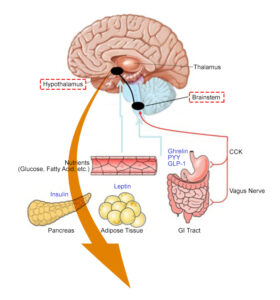
 The Melanocortin 4 Receptor (MC4R) is a G protein-coupled receptor located primarily in the brain’s hypothalamus that plays a master regulatory role in metabolism.
The melanocortin-4 receptor (MC4R) is a G protein-coupled receptor (GPCR) expressed primarily in the central nervous system — particularly the hypothalamus — that plays a critical role in regulating energy homeostasis, appetite, and body weight.
MC4R is a central node in the leptin-melanocortin pathway.
It is activated by anorexigenic (appetite-suppressing) agonists — α- and β-melanocyte-stimulating hormones (MSH), derived from proopiomelanocortin (POMC) — and inhibited by the orexigenic (appetite-stimulating) inverse agonist agouti-related protein (AgRP).
It acts as a critical switch for energy homeostasis, directly controlling appetite, satiety and energy expenditure.
The MC4R pathway is triggered by the hormone α-MSH (melanocyte-stimulating hormone), which suppresses hunger and tells the body to stop eating.
Conversely, when the body needs energy, the AgRP (agouti-related peptide) acts as a natural antagonist to block MC4R, stimulating appetite.
By integrating hormonal signals like leptin (which reflects the body’s nutritional state), the MC4R pathway balances food intake with daily energy expenditure.
MC4R Deficiency and ObesityGenetic Link:
Mutations that cause a loss of function in the MC4R gene are the most common monogenic cause of severe obesity.
Hyperphagia: People with MC4R deficiencies typically suffer from hyperphagia, an insatiable, pathological drive to eat and impaired satiety.
Prevalence: MC4R deficiency affects roughly 1 in 500 people and accounts for 2-5% of cases of severe obesity in children.
MC4R is a major drug target for metabolic diseases and appetite disorders.
Agonists: Drugs like setmelanotide act as MC4R agonists to artificially activate the pathway.
This helps reduce extreme hunger and promote weight loss in patients with specific genetic disorders linked to the leptin-melanocortin pathway.
Drugs that block MC4R are also in development.
These antagonists are being researched to stimulate appetite and prevent muscle wasting in patients experiencing severe weight loss from cancer or infectious diseases.
Upon agonist binding, MC4R primarily signals through the stimulatory G protein (Gαs), activating adenylyl cyclase and increasing intracellular cAMP, which leads to downstream effects on satiety and energy expenditure.
A key structural finding is that calcium (Ca²⁺) serves as a cofactor for MC4R ligand binding, increasing the affinity and potency of α-MSH by 37- and 600-fold, respectively.
The receptor also exhibits constitutive (ligand-independent) activity, maintained by its N-terminal domain, which provides a tonic satiety signal important for long-term energy balance.
MC4R also participates in the regulation of cardiovascular function, glucose and lipid metabolism, reproductive function, pain perception, and autonomic outflow.
Mutations in MC4R represent the most common monogenic cause of obesity, with over 200 distinct variants identified.
Heterozygous loss-of-function variants are found in 1–6% of the severely obese population, particularly in early-onset or childhood obesity.
Homozygous variants are rarer but cause more severe obesity.
Setmelanotide (Imcivree) is an MC4R agonist indicated for chronic weight management in adults and pediatric patients ≥2 years with obesity due to POMC, PCSK1, or leptin receptor (LEPR) deficiency, or Bardet-Biedl syndrome.
It induces biased signaling at MC4R, reducing hunger and producing substantial weight loss in these populations.